
There are faster ways to get from Bangkok to Kanchanaburi. There are cleaner ones, air-conditioned ones, and ones that do not require negotiating a city that appears to have been designed by several committees that never met.
The train is not one of them.
The Death Railway still departs from Thonburi Railway Station. This fact continues to surprise visitors who arrive confidently at Bangkok’s new Krung Thep Aphiwat Central Terminal, expecting efficiency to be contagious. It is not. If you want Kanchanaburi, the River Kwai Bridge, or anything connected with the Thailand–Burma Railway, you must cross the river and recalibrate your expectations.
Thonburi Station does not pretend to be important. Ceiling fans turn without conviction. Wooden benches suggest long familiarity rather than comfort. Coffee is poured into plastic cups because that is what works. The train waits, unhurried, its carriages showing the sort of wear that comes from decades of service rather than neglect.
This is third-class rail travel in Thailand, with no seat numbers. No reservations. No announcements of consequence. Tickets are purchased at the counter on the day for 100 baht. The system is admirably resistant to innovation.
The 07:45 ordinary service leaves with a mild shudder, as if clearing its throat. Windows are open. Fans circulate warm air with limited success. The carriage fills with people who have places to be, but not in a hurry. Students returning home. Elderly couples with shopping bags. A monk who looks as though he has seen this view before and does not require commentary.

The dramatic railway appears to cling to the sheer mountain side offering breathtaking views.
Bangkok retreats gradually. Concrete gives way to canals, then to fields. Water buffalo stand in water that reflects nothing in particular. The city’s noise dissolves into a steady clatter of wheels that never quite becomes rhythmic enough to be comforting.
At Nong Pla Duk Junction, the train pauses again. This is the official beginning of the Thailand–Burma Railway, though nothing at the junction announces it. There are no grand markers. The track bends northwest and carries on.
By late morning, the train arrives in Kanchanaburi, a provincial station that has learned to live with its reputation. The town manages two identities at once. There are the present cafés, guesthouses, weekend visitors, and there is the past, which does not require advertising.
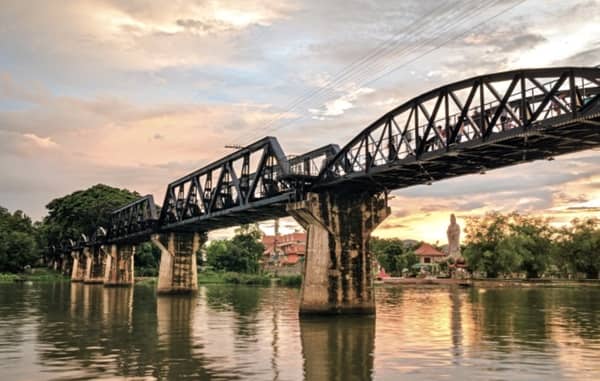
The Bridge on the River Kwai is a short walk away. Its steel spans are familiar enough to feel almost fictional, which is unfortunate, because the reality is less accommodating. The bridge was part of a supply line constructed by the Japanese army during the Second World War, intended to support campaigns in Burma. It worked, in the narrowest sense of the word.
Nearby, the JEATH War Museum provides context without embellishment. The displays are plain. Photographs do the work. The acronym Japanese, English, Australian, American, Thai, Dutch reads like a roll call that never quite ends. Tools worn smooth by forced labour sit in glass cases, unimpressed by attention.
The Thailand–Burma Railway ran approximately 415 kilometres between Ban Pong in Thailand and Thanbyuzayat in Burma. It was built between 1942 and 1943 under conditions that now appear both extraordinary and depressingly familiar: unrealistic deadlines, inadequate supplies, and an assumption that certain lives were expendable.
More than 60,000 Allied prisoners of war worked on the line. At least 12,000 died. Asian civilian labourers, the romusha, were killed in far greater numbers, many without names, records, or acknowledgement at the time. Estimates vary, which is often what happens when accounting is not considered a priority.
Hellfire Pass, also known as Konyu Cutting, remains the most confronting section of the railway. Here, prisoners were ordered to cut through solid rock using hand tools, often working through the night by torchlight. The deadlines were impossible. The consequences were not.
The Hellfire Pass Interpretive Centre approaches the site with restraint. The cutting is left to speak for itself. Rock walls close in. The railway bed remains visible. The imagination fills the silence with sounds that need not be recreated.
From Kanchanaburi, the line continues to Nam Tok, passing wooden trestle bridges and cliffs that drop sharply to the river. Trains still run daily. Schoolchildren still ride them. The railway remains part of ordinary life, which is perhaps its most unsettling quality.
On the return journey to Bangkok, the train does not accelerate. It does not signal progress or improvement. It simply maintains its pace, indifferent to metaphor. The landscape slides past. Passengers doze. Someone opens a snack.
This is not a journey that asks for reverence. It asks for attention, which is a different thing entirely.
The Death Railway still runs because Thailand needs it to. It is neither a monument nor a theme park. It is a working line that carries history, whether anyone onboard is thinking about it or not.
That may be the most honest arrangement possible.
Practical Information
-
Departure station: Thonburi Railway Station, Bangkok
-
Morning service: Ordinary Train No. 257 (approx. 07:45)
-
Afternoon service: Ordinary Train No. 259 (approx. 13:55)
-
Journey time: Approximately 2.5–3 hours
-
Fare: 100 baht (purchase on day of travel)
-
Line continues to: River Kwai Bridge and Nam Tok
by Andrew Wood & edited by Stephen Morton
Read time: 5 minutes.
About the Writer.
 A Yorkshireman by birth and a Bangkokian by choice, Andrew J Wood has been exploring Southeast Asia’s hospitality and culinary landscapes since 1991. A seasoned travel writer, raconteur, and hotel reviewer, Andrew combines old-school courtesy with a dry wit that’s unmistakably English.
His love of gracious service and good manners, traits he believes the world could use more of, shines through every word he writes. From the gleaming hotel lobbies of Bangkok to the bustling markets of Hanoi, he finds joy in the details: a warm smile, a well-brewed cup of tea, or a perfectly folded napkin.
For Andrew, travel isn’t just about movement; it’s about meaning, memory, and the gentle art of slowing down. In his book, the perfect Sunday is unhurried, well-fed, and always finished with something sweet.