
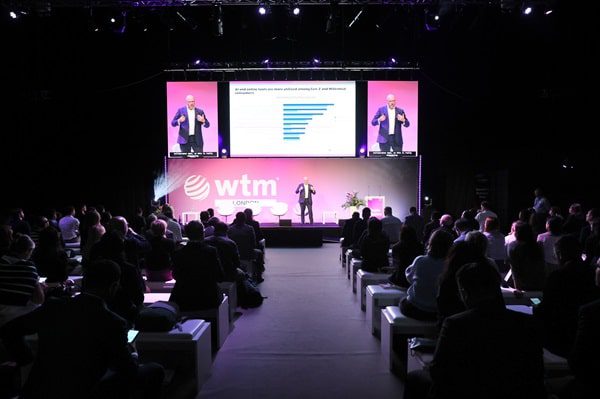
By the final afternoon of WTM London’s Technology Summit, the audience had seen enough PowerPoint slides, forecasts, charts and earnest tech evangelists to last them until next November. Yet it was artificial intelligence, the invisible elephant wandering through the entire three-day fair, that stole the show.
And, true to form, it did so with a debate that felt equal parts parliamentary theatre, TED talk, and late-night panel banter.
The motion was simple enough: AI is the enemy of travel.
Two teams of three lined up to argue the toss, with Protect Group’s Stephen Joyce leading the charge for the proposition, and Magpie Travel’s Christian Watts heading the dissenters. The result, however, was anything but simple.
A “Tough Day for the Humans”
Reservations about AI in the travel world were familiar, even comforting in an old-fashioned way: accuracy, trust, hallucinations, and technology’s habit of being both brilliant and bewildering at the same time.
As Joyce argued, AI-driven itinerary recommendations “remove the magical human chaos of being somewhere new” — a line that won approving nods from traditionalists who still enjoy wandering foreign streets without an algorithm whispering the “top 10 must-dos” in their ear.
But the pro-AI team came armed with the inevitability of progress. Travellers, they noted, are already using AI whether the industry likes it or not and, occasionally, whether AI works or not. Yet its benefits are increasingly hard to dispute: freeing staff from mind-numbing admin, producing faster queries, suggesting destinations travellers may never have stumbled across, and elevating the on-the-ground experience.
When the session moderator finally asked for a show of hands, the verdict was emphatic: AI is a net positive for travel.
Watts, never one to let a punchline escape, conceded that it was “a tough day for the humans,” before adding that the vote likely reflected “not where it is today, but where it’s going to be in the future.”
In other words, AI’s promise outweighed its sins for now.
AI Everywhere: From Fraud Detection to Flying People Around Europe
If the debate crowned AI the unofficial monarch of the summit, the preceding sessions offered clear proof of why the coronation felt inevitable.
Trip.com’s James Spalding revealed that the OTA now uses a global, AI-enabled customer support strategy — one sophisticated enough to adapt itself to different cultural norms and market behaviours. It handles basic queries autonomously, but is also trained to assess tone, complexity and context. Crucially, it knows when to stop pretending and hand the problem to a human.
Over at Almosafer, Qais Amori walked through AI’s growing role in fraud detection, pointing out that fraudsters themselves are already using AI to up their game. In that sense, travel companies may soon need to rely on machine learning to keep pace with the bad guys.
From easyJet, Melissa Skluzacek offered a glimpse into how airlines are quietly leaning on AI across everything from commercial strategy to operational control, describing it as “an extra pair of hands” rather than an ominous takeover.
And NaviSavi founder Sally Bunnell showcased how AI is helping the brand tame the wild frontier of user-generated content, curating and tagging vast libraries of short videos and photos so that travel companies can license them with confidence.
The message across all sessions was consistent: AI is not the future of travel; it is already the workhorse quietly pulling the cart.
The Bigger Picture: Travellers Expect to Spend More with AI
The summit opened on a more macro note, with Tourism Economics’ Dave Goodger unveiling fresh data from the WTM Global Trends Report 2025.
Among the more striking findings:
Three in ten travellers believe AI will increase their average holiday spend.
Higher spending often reflects greater confidence or, perhaps, greater temptation. Suppose AI can tailor an itinerary so precisely that it removes friction, confusion and the dreaded holiday-planning fatigue. In that case, travellers may be more inclined to upgrade, explore and indulge.
Goodger also noted that travel’s growth profile remains positive, offering fertile ground for AI to influence decision-making at an unprecedented scale.
Holafly’s Growth: A Snapshot of Tech Momentum
One company already feeling the benefits of a tech-charged travel rebound is Holafly, WTM London’s official Technology Partner and a global eSIM provider.
Its CEO, Pablo Gómez Fernandez-Quintanilla, highlighted a confluence of forces: more international travel, new expectations for seamless connectivity, the rise of hybrid work, and a growing desire among travellers to stay plugged in without having to navigate SIM cards like it’s 2003.
This blend of technological demand and traveller behaviour has propelled the company forward as a microcosm of the broader digital acceleration reshaping the sector.
A Cautionary Warning: The Look-to-Book Crisis Looms
While most sessions celebrated AI’s promise, one sharp warning stood out.
OAG’s Filip Filipov, armed with a blistering “30 slides in 300 seconds” performance, flagged a potentially enormous operational headache: look-to-book ratios.
At present, major OTAs secure one booking for every thousand searches. But with large language models capable of generating vast numbers of automated trip ideas, recommendations and queries, Filipov predicts that this ratio could balloon to 60,000 to one.
Once agentic AI becomes commonplace?
He warned it could spiral to one million to one.
For an industry already grappling with server load, search costs and bandwidth demands, that number landed like a thud across the room.
The Human Touch: Personalisation vs Contextualisation
Another recurring theme was personalisation, though several panellists stressed a crucial distinction: personalisation isn’t enough. Contextualisation is king.
Knowing who a traveller is matters.
But knowing why they’re travelling a business meeting, a honeymoon, a bucket-list adventure — is often what makes the experience truly meaningful.
It was a reminder that, for all its algorithms and predictions, AI must still grapple with human complexity.
A Sector Bracing for Change – Determined to Improve Travel
Technology Summit organiser Timothy O’Neil Dunne of T2Impact wrapped up proceedings with a wry, clear-eyed assessment of the current landscape.
“Travel’s got a lot on its plate: war, disease, Trump at the same time as generative AI is shaking up how we search, plan and experience travel, with agentic AI beavering away at the back.
“The Summit addressed many of these issues head on. The main takeaway from across all the panellists and sessions is that while disruptive change is inevitable, the travel technology industry is committed to making travel better for real people.”
The sentiment struck a chord. Change is coming fast, unpredictable and occasionally unnerving. But the industry, buoyed by innovation and a little human stubbornness, isn’t shying away.
And if WTM London proved anything this year, it’s that travel’s future won’t be written by AI but by people learning how best to use it.
By Jason Smith – (c) 2025
Read time: 5 minutes.
About the Writer
 Jason Smith has the kind of story you can’t fake, built on long flights, new cities, and that unmistakable hum of hotel life that gets under your skin and never quite leaves. Half American, half Asian, he grew up surrounded by the steady rhythm of the tourism trade in the U.S., where his family helped others see the world long before he did.
Eager to carve out his own path, Jason packed his bags for Bangkok and the Asian Institute of Hospitality & Management, where he majored in Hotel Management and found a career and a calling. From there came years on the road, Singapore, Malaysia, Vietnam, each stop adding another thread to his craft.
He made his mark in Thailand, eventually becoming Director of Sales for one of the country’s leading hotel chains. Then came COVID-19: borders closed, flights grounded, and a new chapter began.
Back home in America, Jason turned his knack for connection into words, joining Global Travel Media to tell the stories behind the check-ins written with the same warmth and honesty that have always defined him.