
It takes a certain confidence to build a dog that inspects trains. Yet there it is, a four-legged, steel-nerved creature trotting politely along the production line at Hitachi Rail’s Maryland factory in the United States. It doesn’t bark, it doesn’t shed, and it never misses a fault.
This $100 million facility, 30 per cent of it devoted to artificial intelligence and digital systems, represents Japan’s engineering mindset in exile: relentless precision, quiet innovation, and an unspoken belief that there’s always a better way to do things.
Here, cameras feed into an AI system that monitors human safety; 3D printers hum away on spare parts; and solar panels power the entire plant. The place hums like a Shinkansen departing Shinagawa at dawn, efficient, immaculate, and improbably on time.
“America’s infrastructure has become extremely outdated. This presents a significant opportunity for us,” said Hitachi President Toshiaki Tokunaga, with the kind of polite understatement that usually precedes something rather spectacular.
The Gospel According to Shinkansen
Long before “innovation” became a buzzword, Japan had already built the real thing. The Shinkansen didn’t just make trains fast; it made them civilised.
No drama, no delays, no excuses, just a nation moving at 300 km/h without spilling its tea.
That philosophy travelled abroad in 2007, when Taiwan High Speed Rail began service using Shinkansen technology. Seven Japanese giants, Mitsubishi Heavy Industries, Toshiba, Kawasaki, Mitsui, Marubeni, Sumitomo, and Mitsubishi Corporation, joined forces, backed by the quiet discipline of JR Central and JR West engineers.
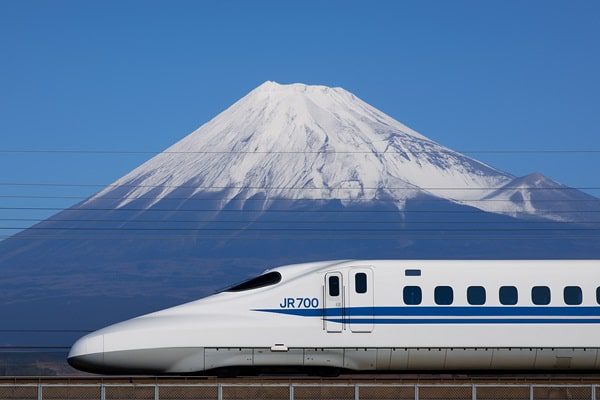
Together, they built a line that whisked passengers from Taipei to Kaohsiung faster than you can say bento box. The trains mirrored Japan’s 700-series workhorses: beautiful, reliable, and incapable of running late.
It was the first time the “Made in Japan” label had rolled along international rails. It wouldn’t be the last.
Jakarta’s Great Leap Forward
Jakarta, bless it, used to treat traffic jams as a national sport. So when Indonesia’s first Mass Rapid Transit (MRT) line opened in 2019, the relief was audible from the airport to the archipelago.
Backed by Japan’s Official Development Assistance (ODA), the project was a symphony of Japanese coordination: Shimizu and Obayashi dug the tunnels, Mitsui installed the brains, and Sumitomo, with Nippon Sharyo, delivered the carriages.
At first, local workers were perplexed by the Japanese insistence on millimetre accuracy. Wasn’t “close enough” good enough? Not in Tokyo, it isn’t.
Patiently, Japanese engineers taught safety routines in Bahasa, calling out “kanan aman” (right clear) and “kiri aman” (left clear) before crossing tracks. Within months, that blend of rigour and courtesy had caught on. Today, the Jakarta MRT runs like a watch, and everyone points and calls, just as the Japanese do.
Dhaka’s Metro: A Train of Hope
In Dhaka, a city of chronic congestion and heroic patience, Japan helped build something remarkable: MRT Line 6, Bangladesh’s first metro system.
Funded through Japan’s long-term, low-interest loans and its Infrastructure System Export Strategy, the project brought more than trains. It brought dignity.
One carriage in each train is reserved exclusively for women, a small but powerful step in a country where harassment on buses is a grim daily reality. “It’s not just about getting to work,” said one commuter. “It’s about feeling safe doing it.”
Even the stations bear Japan’s quiet fingerprint: tactile paving, wheelchair-friendly lifts, spotless restrooms. Such details may seem small, but they speak volumes about a culture that prizes accessibility and empathy as much as efficiency.
Saigon Style: When Metro Meets Selfie
Then there’s Ho Chi Minh City, where Vietnam’s first metro line opened in 2024 and instantly became the new Instagram darling.
Couples in ao dai pose at turnstiles, and families photograph the ticket gates. Behind the scenes, Japanese precision keeps the lights on: Hitachi trains, Shimizu tunnels, Sumitomo oversight, Tokyo Metro training.
It’s modern Vietnam wrapped in Japanese order, equal parts selfie and substance.
Europe: The Polite Invasion
When Hitachi entered Britain’s rail market in 1998, few took it seriously. The holy trinity of train-making dominated Europe: Siemens (Germany), Alstom (France), and Bombardier (Canada).
But as any Shinkansen conductor could tell you, timing is everything.
By 2005, Hitachi had landed the contract for Britain’s Class 395 trains, the first taste of Japanese punctuality for commuters long resigned to British delays. Then came Italy’s ETR1000, sleek as a sports car and topping out at 350 km/h, a full notch above Japan’s own Shinkansen speeds.
Now, Hitachi trains glide across Italy, Spain, and France, proof that the island nation that gave the world karaoke can also teach it how to run on time.
India’s Long Road to Speed
In 2015, India announced with great fanfare that it would adopt Japan’s Shinkansen system for its first bullet train. The plan was bold: connect Mumbai and Ahmedabad at high speed, using Japan’s E5 series trains.
Reality, of course, intervened. Costs climbed; schedules wobbled. India revised the plan, opting to launch with locally built trains in 2027 and to upgrade later with Japan’s new E10 series.
It’s less a setback than a lesson in pragmatism: the rails of progress are rarely straight.
When Technology Is Also Philosophy
What makes Japan’s railway legacy endure isn’t just metal and mechanics; it’s the mindset.
This is a country where a single minute’s delay earns a company apology, and where conductors bow before empty carriages. It’s a railway culture forged in earthquakes, typhoons, and the sheer unpredictability of life, yet trains run with the serenity of a tea ceremony.
The engineering is world-class, yes. But it’s the ethic behind it, the refusal to cut corners, the belief that safety is sacred, that has made Japan’s railways the envy of the planet.
The Next Station: The World
Japan’s population is shrinking; domestic ridership is falling. But its railway expertise has found a new audience overseas, from the underground tunnels of Jakarta to the solar-powered factories of Maryland.
Hitachi now operates in over 50 countries and aims to double its rail revenue to ¥2 trillion by 2030. Its rivals, Siemens, Alstom, and CRRC may have the numbers, but few have Japan’s quiet moral authority in the field.
Every train that leaves a Japanese plant carries more than passengers. It carries a promise that precision and humanity can still share the same track.
By Charmaine Lu – (c) 2025
Read time: 7 minutes.
About the Writer
 Charmaine has always had a quiet kind of courage. She grew up in Shanghai, a city that moves at a tempo all its own, and somehow managed to keep her own rhythm studying accounting for the discipline, then the arts for the sheer love of beauty. “I needed both,” she says, “to feel whole.”
When she left China for Sydney in the 1980s, she carried nothing but a degree, a suitcase and a belief that she could start again. The first sea breeze off the harbour felt like permission. She met Stephen, and together they built a family, two children, a home filled with laughter, and a life straddling two cultures without apology.
Work has always been more than a job. Long before search engines became the centre of commerce, Charmaine was quietly helping companies be found and read—not just SEO but stories people wanted to click on. That is still her gift: finding connection in a crowded world.
Her life is less a résumé than a testament to grace under change, the accountant’s discipline, the artist’s eye, and a heart big enough for two continents.