

In Dubai, the temperature rarely drops below thirty degrees, and neither, it seems, do the profits at Emirates Group.
The latest half-year results have landed with a thud loud enough to make accountants smile and rivals wince: a pre-tax profit of AED 12.2 billion (US$3.3 billion) for the six months to September 2025. That’s a 17 per cent rise on the same period last year and the fourth consecutive record half-year. In an industry where turbulence is usually the rule, Emirates has managed a smooth climb and then some.
A Profitable Pattern Emerges
Airlines, by nature, flirt with danger: pandemics, fuel prices, wayward volcanoes, pick your poison. Yet Emirates continues to defy gravity. Group revenue rose to AED 75.4 billion (US$20.6 billion), profit after tax reached AED 10.6 billion (US$2.9 billion), and EBITDA touched AED 21.1 billion (US$5.7 billion). Even the cash balance is impressive: AED 56 billion (US$15.2 billion) now sits happily in the bank.
It’s a performance that leaves many national carriers looking faintly embarrassed, a reminder that Dubai, once the stopover city of duty-free watches, has evolved into a capital of aviation dominance.
Sheikh Ahmed: Calm at the Controls

His Highness (HH) Sheikh Ahmed bin Saeed Al Maktoum, Chairman and Chief Executive, Emirates Airline and Group
At the top sits His Highness Sheikh Ahmed bin Saeed Al Maktoum, Chairman, Chief Executive and, in many ways, Emirates’ spiritual pilot. He was in a characteristically composed mood when he announced the results:
“The Group has once again delivered an outstanding performance, surpassing our half-year results of last year to achieve a new record profit for H1 2025-26. I’m delighted to note that Emirates maintains its position as the world’s most profitable airline for this half-year reporting period.”
In the understated world of Gulf boardrooms, that’s the equivalent of a standing ovation.
Sheikh Ahmed credited the airline’s “unflagging demand and growing customer preference”, polite shorthand for the fact that, while some carriers still wrestle with staffing shortages and service cuts, Emirates has been busy refurbishing A380s, rolling out Premium Economy, and reminding the world that glamour still sells.
The Engine Room: Emirates Airlines
The airline itself accounted for AED 11.4 billion (US$3.1 billion) of the Group’s profit before tax, a record in its own right. Passenger numbers climbed 4 per cent to 27.8 million, while revenue rose 6 per cent to AED 65.6 billion (US$17.9 billion).
Those numbers aren’t mere bookkeeping. They tell a story of travellers returning to the skies with a vengeance and choosing, more often than not, the carrier with the gold logo and polished service.
In the first six months of the financial year, Emirates launched routes to Danang, Siem Reap, Shenzhen and Hangzhou, while bolstering capacity to Rome, Riyadh, Johannesburg and Taipei. The airline now serves 153 airports across 81 countries, a map so dense it would make any frequent flyer’s app blush.
Five new Airbus A350s joined the fleet, and 23 existing aircraft (6 A380s and 17 Boeing 777s) emerged from the airline’s lavish US$ 5 billion retrofit program, featuring the now-famed Emirates Premium Economy cabins. The airline also opened “Emirates First” at Dubai Airport, a private check-in experience for first-class and Platinum Skywards members, where the welcome drink probably costs more than most airlines’ in-flight meals.
Cargo with a Touch of Class
Meanwhile, Emirates SkyCargo, the quiet achiever of the operation, moved 1.25 million tonnes of freight in six months, up 4 per cent on the year. Cargo yields dipped slightly (down 6 per cent), but volumes held steady. New Boeing 777 freighters were delivered, and the division launched Emirates Courier Express, offering door-to-door deliveries for businesses that like their parcels shipped with the same polish as their passengers.
Not content with moving goods, Emirates has also been busy moving hearts or at least jerseys. Sponsorships now include FC Bayern Munich, Real Madrid Basketball, European Professional Club Rugby, and a renewed partnership with the ATP Tour through 2030. Emirates isn’t just in aviation anymore; it’s a brand ambassador for aspiration.
dnata: The Unsung Multitasker
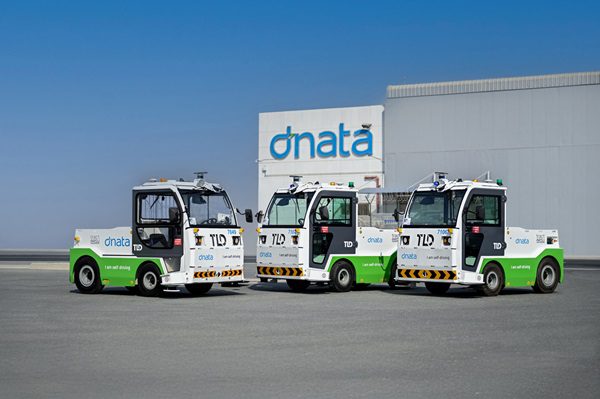
dnata H1 25-26
While Emirates grabs headlines, dnata, the Group’s ground-handling and services arm, quietly turns a profit of its own.
Revenue rose 13 per cent to AED 11.7 billion (US$3.2 billion), while pre-tax profit hit AED 843 million (US$230 million). It’s the first time dnata’s half-year revenue has crossed the US$3 billion mark.
The company handled 450,903 aircraft turns, a 15 per cent rise, and 1.59 million tonnes of cargo. It has invested US$110 million in new low-emission ground support equipment because even baggage tugs need a greener conscience these days.
dnata’s catering and retail arm contributed AED 4.1 billion, up 11 per cent, while its travel division, including the newly acquired WonderMiles platform, added another AED 2 billion in revenue. It also leapt into sports, becoming a founding partner of Dubai Basketball, a rather neat metaphor for its vertical ambitions.
The Bigger Picture: Dubai’s Playbook
If you’re wondering how Dubai keeps this up, the answer lies in its DNA, and perhaps its initials: D-N-A, Dnata by name, determination by nature.
Dubai’s aviation strategy has long been to build bigger while others blink. During COVID-19, while airlines parked jets and furloughed crews, Emirates invested. Now it’s reaping the dividends. With Dubai positioning itself as both a global crossroads and a corporate magnet, the Group benefits from traffic that never really slows.
The Group’s workforce now tops 124,900, up 3 per cent since March. Recruitment drives continue across the board a pleasant contrast to airlines elsewhere still hunting for cabin crew.
Fuel, Fortune and Foresight
Fuel remains 30 per cent of operating costs, not insignificant, but manageable. Emirates has offset some volatility through clever purchasing and hedging strategies. It has also dipped its wings into sustainability, using sustainable aviation fuel (SAF) at 37 airports where feasible and joining the Aviation Circularity Consortium, which aims to recycle and repurpose aviation materials in the drive toward net zero.
That said, Sheikh Ahmed’s view of sustainability is refreshingly pragmatic. He’s not one for the pious sermon; his approach is about engineering efficiency rather than public penance. In a world of greenwashing, that honesty is almost refreshing.
Rivals and Reflections
To appreciate the scale of Emirates’ success, consider that its AED 12.2 billion pre-tax profit equates to roughly A$5.1 billion — more than the combined interim profits of several national carriers. Australia’s own flag carrier has been busy mending fences after customer service stumbles and leadership churn; Emirates, by contrast, has quietly polished its silverware and carried on.
While European airlines battle cost inflation and America’s majors juggle staff shortages and union talks, Emirates has done what it always does: expand, enhance and execute.
It’s tempting to see it as hubris, the sort of ambition that might make even Icarus squirm, but so far, the strategy has worked.
The Human Touch
Behind the gloss lies a workforce that’s increasingly international and youthful. Emirates employs people from more than 170 nationalities, a fact Sheikh Ahmed likes to repeat. The company insists that this diversity fuels innovation, a polite way of saying that people who grew up on opposite sides of the world somehow manage to agree on serving afternoon tea at 30,000 feet.
It’s also part of Dubai’s broader ambition to present itself not merely as a city, but as a global talent hub, a place where borders are paperwork, not obstacles.
Storm Clouds? Possibly. Panic? Hardly.
No airline is immune to turbulence. Geopolitical tension, softening freight demand and potential aircraft delivery delays all loom large. But Emirates has weathered worse. Its cash cushion and diversified income mean it could survive a rough patch without spilling the champagne.
The bigger question is strategic: how long can the Dubai model’s vast capacity, funnelled through a single hyper-hub, continue to grow before congestion bites? The forthcoming A350s and dnata’s new facilities should help, but infrastructure will always race to keep up with ambition.
A Lesson for the Rest of the Industry
If there’s a moral to this story, it’s not simply that Emirates is rich. It’s that discipline, investment, and consistency still matter in aviation, perhaps more than ever. While some airlines chase trends or cheap seats, Emirates doubles down on quality and service. In the era of low-cost everything, that’s almost revolutionary.
It’s worth recalling that when Emirates launched in 1985 with just two leased aircraft, few took it seriously. Forty years on, it’s setting global benchmarks while keeping its home city in the headlines and in the black.
Final Approach
For travellers, the message is simpler still. The next time you board an Emirates flight and wonder how the airline affords those generous pours of Veuve Clicquot or the gentle hush of its Premium Economy, remember this: it can, because it does everything else well.
Profits like these don’t fall from the sky. They’re engineered, meticulously maintained, and executed with the precision of an A380 touchdown. Emirates isn’t merely flying high; it’s redefining what altitude looks like in modern aviation.
And if there’s a touch of envy in the industry’s applause, well, that’s just the sound of competition gasping for air.
By Stephen Morton – (c) 2025
Read time: 9 minutes.
About the Writer
 Stephen Morton has spent nearly five decades shaping how the travel industry works, talks, and sells itself. From the family-run agency of 1976 to today’s digital frontier, Morton has been at the front of the queue, often long before anyone else knew there was a queue.
By the mid-nineties, he was dragging Agents Support Systems online while the industry still worshipped the fax machine. In 2001, he launched e-Travel Blackboard (eTB), a daily newsletter that became Australia’s most read industry bulletin and expanded across New Zealand, Asia, the Americas, and into MICE.
In 2009, Global Travel Media came, going on to scoop multiple international awards, including Best Travel Industry Website and Outstanding Digital Media Service. Later came Destination Thailand News, Global Cruise News, and now, in 2025, GTM Holidays and the forthcoming GTM Mall.
Whether lecturing students or launching titles, Morton has always been ahead of the curve, a travel industry stalwart who has turned instinct into impact.