
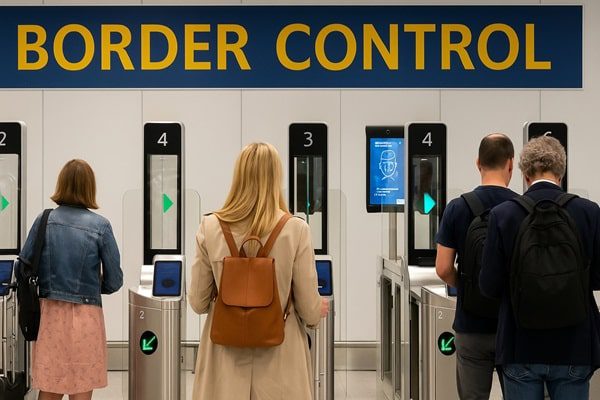
In the ever-changing world of travel, one thing remains steadfast: you don’t ignore your documents (or your insurer) and expect smooth sailing. With the Entry/Exit System (EES) now active across the Schengen Area, it’s time for Australian travellers to wake up to a new border-control reality and ensure their travel insurance keeps pace.
The European Union’s long-awaited EES is officially live, ushering in what could be called the digital frontier of border checks. No longer will you stroll through and receive a friendly passport stamp; instead, you’ll be greeted by biometric scans, facial recognition and fingerprint logs. On first entry to the Schengen Area, your biometric data will be captured, and your presence will be logged digitally.
To add a future layer of complexity, the upcoming European Travel Information and Authorisation System (ETIAS), expected in 2026, will require non-EU travellers to obtain pre-travel authorisation, which is effectively a travel permit. These changes signal that border control is entering a new era of tech-driven rigour.
While the intention behind EES is solid — faster border processing and tighter security, the immediate effects could be somewhat less glamorous for the unsuspecting traveller. Longer queues, airport delays, and added paperwork are very much on the cards, especially at busy hubs such as Charles de Gaulle Airport (Paris), Frankfurt Airport, Adolfo Suárez Madrid–Barajas Airport (Madrid) and Leonardo da Vinci–Fiumicino Airport (Rome). In addition, most travellers are still acclimatising to the system, and you have the perfect recipe for pre-travel unease.
“The EES isn’t a visa, but it is a new entry requirement. If you arrive unprepared or don’t allow enough time for border processing, you could face lengthy delays, miss your connection or, in some cases, be refused entry,” warns Natalie Ball, Director of CompareTravelInsurance.com.au.
Ball offers some practical advice and a stark reminder that travel insurance is not an optional extra but a necessary shield. She notes that travellers needing a visa under Schengen rules must hold travel insurance with at least €30,000-€35,000 in medical coverage, including emergency hospital care and repatriation. Under Schengen rules, visa applicants must carry proof of travel insurance. With digital border checks, this documentation may be scrutinised more consistently. Even in an increasingly digital travel landscape, passports and appropriate insurance remain essential,” she adds.
It must be stressed: travel insurance may not step in if delays are caused by something entirely predictable. “If a system outage at passport control causes delays, you may have grounds for a claim. But if you simply underestimated how long the checks would take, you’re unlikely to be reimbursed,” Ball clarifies.
Why this matters
For decades, the traditional “passport stamp, quick look, move on” model sufficed. But with the EES, we’re moving into what could be called Phase Two of border control biometric capture, digital logging, and pre-authorisations. The implications are far-reaching:
-
Heightened scrutiny: The transition from stamp to scan means data capture and retention, which means more checks, more verification, and less of the “wing it and hope for the best” approach.
-
Insurance becomes strategic: It’s no longer just “do I need it?” but “am I adequately covered for this new environment?”.
-
Stranded-traveller risk increases: Missed connections, delays and refusals of entry are real risks under the new regime — and if your insurance doesn’t cover predictable risk, you may be out of pocket.
-
Timing matters: First-time entry under EES may take longer, so planning becomes paramount.
Travel helpers: five smart tips
-
Arrive early: Plan to allow extra minutes, as the biometric capture needs time, especially during roll-out phases.
-
Check your documents: Ensure your passport is valid, can be scanned easily, and has your travel authorisation (once ETIAS launches) in hand.
-
Ensure you’re insured: All Schengen-region visa applicants must carry appropriate travel insurance. Make sure you’re covered for at least AUD $35,000 (or equivalent) in overseas medical, including emergency care and repatriation.
-
Prepare for your first trip: Initial checks may take longer than expected; factor in the unknowns.
-
Review the policy fine print: Many insurers will not pay out for delays caused by things you could’ve predicted (like busy airports or longer lines).
Know your entry requirements.
-
ETIAS (European Travel Information and Authorisation System): Expected to launch in late 2026, this system will require prior approval for non-EU travellers to travel to the Schengen Area.
-
UK ETA (Electronic Travel Authorisation): If you are bound for the UK, it’s worth noting the ETA requirement there, too. Non-EU visitors may need to apply before arrival.
Ball reminds travellers of the simple truth: new technology doesn’t replace attention to detail. “As with any new border system, hiccups are possible,” she says. “Travellers should plan ahead, leave extra time, and make sure they understand the new requirements. Digital borders don’t replace important documents, and travel insurance is more important than ever.”
Final word
In the old days, you rocked up, showed your passport, and went off. Those days are fading. The digital frontier of European border control is here, and savvy travellers will step up their preparation accordingly. Travel insurance? It’s no longer the afterthought you buy in the departure lounge; it’s a frontline defence.
So take the time, check the policy, step up your planning, and don’t be the flustered tourist caught at the gate. When the EES door swings open for you, make sure you’re walking through, not stuck in a queue with the camera flashing, inadequate insurance, and regret on your boarding pass.
By Christine Nguyen – (c) 2025
About the Author
 Christine’s journey is one of quiet courage and unmistakable grace. Arriving in Australia as a young refugee from Vietnam, she built a new life in Sydney brick by brick, armed with little more than hope, family, and a fierce curiosity about the wider world. She studied Tourism at TAFE and found her calling in inbound travel, working with one of Sydney’s leading Destination Management Companies—where she delighted in showing visitors the real Australia, the one beyond postcards and clichés.
Years later, when the call of the sea and a gentler pace of life grew stronger, Christine and her family made their own great escape. She turned her creative hand to designing travel brochures and writing blogs, discovering that storytelling was as natural to her as breathing. Today, she brings that same warmth and worldly insight to Global Travel Media, telling stories that remind us why we travel in the first place.