
In the mercurial world of hotel economics, Hilton has developed a knack for keeping its tie straight while the rest of the industry fidgets. The US-based hospitality giant turned in a robust third-quarter result, booking US$421 million in profit and lifting its development pipeline to a record 515,400 rooms, even as revenue per available room, the hotel industry’s heartbeat, fluttered slightly lower.
That resilience, delivered in an otherwise lukewarm travel market, reinforces a familiar truth in hospitality: global reach and brand depth can paper over several local wobbles.
A measured performance, strong on substance
For the three months to 30 September, Hilton’s adjusted EBITDA rose to US $976 million, up from US $904 million a year earlier. However, diluted earnings per share hit US $2.11 after adjustments, a tidy lift from US $1.92.
System-wide RevPAR slipped 1.1 per cent on a currency-neutral basis, but that didn’t stop management and franchise fee revenue from climbing 5 per cent. The result underscores Hilton’s asset-light model: even when guests tighten belts, the franchisor keeps skimming fees from 9,000 hotels worldwide.
“Our third-quarter results continue to demonstrate the resilience of our business model, delivering strong bottom-line performance despite softer industry RevPAR,” said Christopher Nassetta, Hilton’s President & CEO, with the calm of a man who has steered through three recessions.
He added that lower interest rates and “a significant investment cycle” should boost travel demand and RevPAR in the coming years. This is corporate-speak for “don’t panic; this is a soft patch, not a slide.”
Building while others blink
If Hilton’s ledger is steady, its construction diary is exuberant. During the quarter, the group approved 33,000 new rooms and opened 199 hotels, including the Conrad Hamburg (its first in Germany) and KROMO Bangkok, the debut Curio Collection property in Thailand. In Vietnam, five new projects will carry the Conrad, LXR and DoubleTree flags, reflecting Hilton’s accelerating push across Asia.
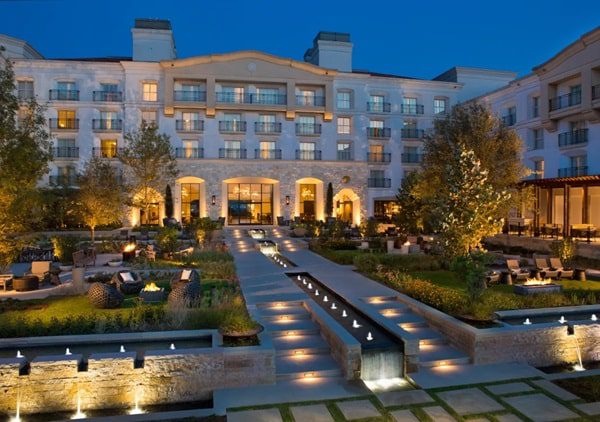
The quarter’s jewel was the 9,000th Hilton property, the Signia by Hilton La Cantera Resort & Spa in Texas. That milestone coincided neatly with the debut of a new lifestyle marque, the Outset Collection by Hilton, which already boasts more than 60 developing hotels. Bookings are due to open before year-end.
For a company founded in 1919, Hilton has shown a start-up appetite for product segmentation. From the stately Waldorf Astoria to the cheerful efficiency of Tru by Hilton, the brand ladder now resembles a hedge against economic mood swings.
Regional contrasts, global gains
Not every region sang from the same hymn sheet. The US market dipped 2.3 per cent in RevPAR, while Europe managed a 1 per cent gain, and the Middle East and Africa surged 9.9 per cent. Asia-Pacific was essentially flat (-0.1 per cent) but steadied by new signings and a still-recovering outbound sector.
Hilton’s total portfolio now spans 141 countries, and nearly half of all pipeline rooms are under construction, an enviable feat in an industry still paying more for materials and debt.
Cash, capital and the comfort of buy-backs
Behind the polished lobbies lies a tidy balance sheet. Net debt is US$10.6 billion, with no significant maturities until 2027 and an average interest rate below 5 per cent. Cash reserves hover around US$1.13 billion to keep the dividend ticking at US$0.15 per share.
The group repurchased 2.8 million shares in the quarter at an average of US$270 apiece, part of US$792 million returned to shareholders. Year-to-date capital return is US $2.67 billion, heading for US $3.3 billion by December.
In plain English: even if travel slows, Hilton still throws off cash like a well-oiled minibar.
Luxury leads, mid-scale matters
Hilton’s top-shelf brands held firm. Waldorf Astoria, Conrad, and LXR Hotels & Resorts lifted occupancy by 2–4 points year-on-year, while Hampton, Garden Inn, and DoubleTree delivered the lion’s growth share.
That blend of prestige and predictability remains Hilton’s quiet advantage, the champagne and sparkling water of global travel.
Outlook: steady hands, firm nerves
Full-year forecasts call for flat to 1 per cent RevPAR growth, net income of US $1.6 – 1.63 billion, and Adjusted EBITDA of around US $3.7 billion. Adjusted EPS should land between US $7.97 and US $8.06, which is not spectacular but eminently bankable.
Hilton also projects 6.5–7 per cent net unit growth, proof that its building spree is less gamble than muscle memory.
A century on, still playing offence
Hilton’s growth instinct remains distinctly modern for a firm that began in the age of telegrams. It’s still opening nearly 25,000 rooms per quarter, and its EBITDA margin hovers near 75 per cent, a figure that would make most hoteliers blush.
As Nassetta put it with studied restraint, Hilton is “confident in delivering sustainable long-term growth.” Translation: it’s minting cash and doesn’t intend to apologise.
Travel’s bellwether still rings true.
Hilton’s third-quarter figures are more than an earnings call; they’re a pulse check on the world’s wanderlust. A minor RevPAR wobble beside a record development pipeline says as much about global optimism as it does about Hilton’s muscle memory.
If clouds gather, Hilton has cash and credibility; if the sun stays out, it has 515,000 rooms waiting to be filled. As one analyst dryly observed, “Hilton doesn’t chase the cycle, it outlasts it.”
That, surely, is the secret.
By Jason Smith
About the Author
 Jason Smith has the kind of story you can’t fake, built on long flights, new cities, and that unmistakable hum of hotel life that gets under your skin and never quite leaves. Half American, half Asian, he grew up surrounded by the steady rhythm of the tourism trade in the U.S., where his family helped others see the world long before he did.
Eager to carve out his own path, Jason packed his bags for Bangkok and the Asian Institute of Hospitality & Management, where he majored in Hotel Management and found a career and a calling. From there came years on the road, Singapore, Malaysia, Vietnam, each stop adding another thread to his craft.
He made his mark in Thailand, eventually becoming Director of Sales for one of the country’s leading hotel chains. Then came COVID-19: borders closed, flights grounded, and a new chapter began.
Back home in America, Jason turned his knack for connection into words, joining Global Travel Media to tell the stories behind the check-ins written with the same warmth and honesty that have always defined him.