
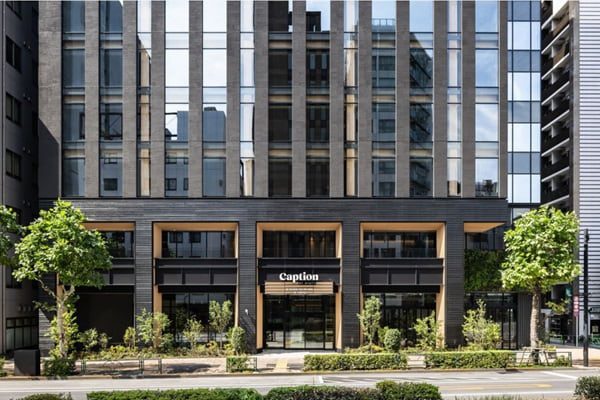
Tokyo, a city that never seems to run out of new beginnings, has just gained another.
This time, it arrives in the shape of a 195-room hotel that takes its cues not from gilt lobbies or starched uniforms, but from the streets’ rhythm.
Caption by Hyatt Kabutocho Tokyo has opened its doors in the capital’s rejuvenated financial district. This neighbourhood once defined the old economy and is now reinventing itself as a hub of ideas, design, and conversation.
In many ways, it is Hyatt’s most interesting statement in years.
A Brand That Prefers Conversations Over Chandeliers
When Hyatt Hotels Corporation launched its Caption brand in 2022, it promised something “upscale, but not uptight.”
That promise has come to life in Kabutocho.
The hotel is a short walk from Kayabacho and Nihonbashi subway stations, and Tokyo Station and Ginza are within striking distance.
The location is clever: close enough to the business grid to attract executives, but immersed enough in local life to lure a younger, design-minded crowd.
The property’s soul is Talk Shop, an open, all-day café-bar-workspace hybrid that acts as the hotel’s social heart.
It’s where guests check in, meet locals, and debate everything from stock movements to where the best ramen hides.
General Manager Masa Yamada describes it as a place that “connects people with each other and with the neighbourhood, where traditions and new ideas meet.”
It’s a neat summary of what Kabutocho has become: Tokyo’s answer to Wall Street, with a hipster aftertaste.
A Café That Doubles as a Community
If you walk into Talk Shop at 8 a.m., you’ll find traders grabbing espresso before the Tokyo Stock Exchange bell.
Come back at sunset, and the place hums with laughter, clinking glasses, and the smoky aroma of a Japanese Holstein beef burger sizzling on the grill.
That burger, the house Caption Burger, has become the brand’s unofficial mascot. It’s unapologetically hearty, layered with bacon and American cheese, and finished with a sauce that defies description but somehow works.
Those leaning towards lighter fare can opt for a chickpea burger with a yoghurt-herb dressing, proof that Tokyo’s plant-based scene is finally getting the attention it deserves.
Add SR Coffee Roaster’s custom blend or a Heiwa Craft beer from Wakayama, and you will begin to understand why Talk Shop isn’t merely a hotel restaurant. It’s a pulse point.
The vibe shifts with the day. In the morning, laptops and lattes are the norm, while by night, cocktails and jazz are the norm.
It’s less a lobby than a declaration that hotels can and perhaps should become neighbourhood living rooms.
Design That Speaks Fluent Tokyo
Unlike many chains that decorate by formula, Hyatt took a risk here: it hired Mitchell & Eades, an Australian design studio known for narrative architecture rather than safe corporate polish.
Their inspiration came from Kabutocho’s past Japan’s “Wall Street” and the hand signals once used by stockbrokers on the trading floor.
That visual language now informs patterns, textures, and motifs across the building, resulting in interiors that feel both grounded and expressive.
The 195 rooms, divided into four themes—“Bridge,” “Community,” “Old & New,” and “Future”—act like chapters in a Tokyo storybook.
One might feature exposed concrete softened by washi textures, while another could feature a mural recalling Kabutocho’s lively markets.
Rooms range from compact standards (22–28 square metres) to suites (54 square metres) equipped with washer/dryers for long-stay guests.
Bath amenities by Brooklyn’s Apotheke lend a contemporary edge, a subtle reminder that design diplomacy between New York and Tokyo is alive and well.
One Hyatt executive says the goal was to create a place that “feels designed, not decorated.”
They’ve succeeded.
Community First, Always
What truly distinguishes Caption by Hyatt is not its square footage but its philosophy: hospitality as participation.
The hotel might host a chiyogami notebook-making workshop or a live jazz session featuring emerging Tokyo artists on any given week.
These are not window-dressing events for Instagram; they’re genuine invitations to mingle, make, and belong.
The on-site market is open 24/7, and it stocks ready-to-eat bites, travel essentials, and handcrafted items from Nihonbashi’s long-standing artisans.
There’s even a touch of humour in the merchandising, hand-wrapped soaps and paper goods bearing winking captions that make you smile before your morning coffee.
This hotel quietly asserts that connection still matters in a city famous for anonymity.
Green Thinking, Steel and Timber
Sustainability isn’t just a brochure word here.
The property is the first hotel in Tokyo to earn the Development Bank of Japan’s (DBJ) Green Building Certification—Plan Certification, which recognises buildings that combine environmental innovation with community benefit.
Its hybrid timber-and-steel structure trims its carbon footprint and serves as a prototype for what Japanese urban architecture could become, lighter, cleaner, and, crucially, scalable.
The team didn’t stop at the framework.
Water stations on every floor reduce bottled waste, while bathrooms feature paper toothbrushes and refillable amenities to cut single-use plastics.
It’s not glamorous sustainability; it’s pragmatic, engineer-minded, Tokyo-practical sustainability that actually endures.
Details about the certification program are publicly available on the DBJ Green Building site, a reminder that the small print sometimes hides the real story.
An Opening with a Local Twist
Caption by Hyatt Kabutocho Tokyo is running a Grand Opening Offer through January 31, 2026, to celebrate its debut.
Guests booking directly with Hyatt receive a doburoku-based welcome cocktail with rustic, unfiltered sake that predates Japan’s modern brewing traditions.
For those who abstain, there’s a non-alcoholic version with nearly the same earthy depth.
Each guest also receives a limited-edition gift box, assembled with Nihonbashi artisans, giving new meaning to the term “takeaway.”
Meanwhile, World of Hyatt members earn 500 bonus points per qualifying night during the same period, an unusually generous gesture that hints at Hyatt’s determination to draw travellers from its competitors.
Full details are on worldofhyatt.com/newhotelbonus.
Hyatt’s Bigger Bet on Human-Scale Hospitality
This is more than just another opening in Hyatt’s global spreadsheet.
It’s part of a larger rethink within the brand—a recognition that travellers no longer measure luxury by thread count or wine lists, but by relevance.
The Caption by Hyatt series, now in Nashville, Osaka, Shanghai, and Tokyo, operates on that premise: deliver design-forward spaces where people don’t merely sleep, but interact.
It’s an antidote to sameness and positions Hyatt squarely within the new hospitality conversation—a field where authenticity now outranks opulence.
In that sense, Kabutocho is both symbol and experiment.
It proves that a hotel can remain profitable without compromising warmth, and that sustainability does not need to sacrifice style.
If it succeeds—and by early accounts, it’s well on its way – expect the brand to expand rapidly across Asia’s megacities, from Seoul to Singapore.
A Final Word from Tokyo’s New Gathering Place
Step outside Caption by Hyatt Kabutocho Tokyo at night, and you’ll see what Hyatt is betting on.
Not the skyline, not the foot traffic, the people.
Couples share craft beers on the steps, solo travellers scroll through photos under softly glowing lanterns, and a few locals, once strangers, stay for “just one more song” as a jazz trio plays inside.
It’s not a grand hotel in the old sense.
It’s something rarer: a space that feels local and universal, curated yet effortless.
And in Tokyo, where reinvention is an art form, that might be the most luxurious idea.
For reservations and details, visit Caption by Hyatt Kabutocho Tokyo.
By My Thanh Pham
BIO
 My Thanh Pham has worn more travel hats than most luggage racks could hold. After taking a course in travel and tourism, she found herself deep in the business of arranging itineraries across South-East Asia, matching travellers to temples, beaches, and the occasional night train, with a knack for making the complicated look easy.
Not content with life behind the desk, she joined a Vietnamese airline, juggling reservations one day and the frontline bustle of the airport the next. It gave her a ringside seat to the theatre of travel: the missed flights, the joyous reunions, and the endless stories that airports never fail to serve.
These days, My Thanh has swapped ticket stubs for a writer’s keyboard at Global Travel Media. Her words carry the same steady hand she once brought to bookings, guiding readers through the rich, unpredictable world of travel.