
It’s been called a revolution before, when the internet came along, then again when smartphones became our travel agents. But this time, it’s not a gadget or a website. It’s infrastructure.
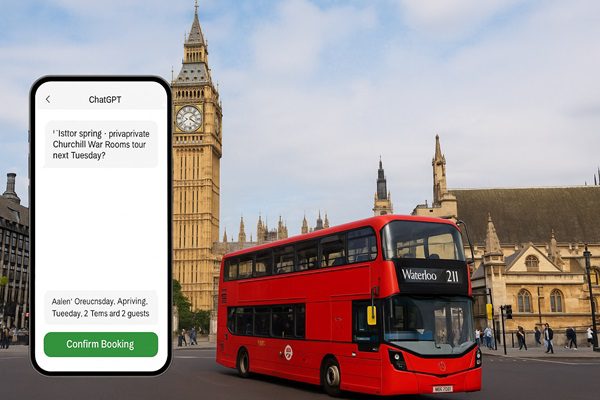
OpenAI’s latest move to let ChatGPT users seamlessly shift from discovery to direct booking has set off the loudest tremor in tourism since the first online reservation system blinked to life. A traveller can now ask the chatbot for a “private Churchill War Rooms tour next Tuesday” and walk away with a confirmed ticket- no website clicks, no log-ins, no middleman.
One industry insider observed, “When the booking button lives inside the conversation, the middlemen vanish faster than a budget flight on Boxing Day.”
A seismic shift in how bookings happen
For London’s tour operators, the shift isn’t theoretical. It’s immediate, measurable, and, in many cases, confronting. The operators who have invested in real-time inventory, structured availability, and instant confirmation systems are already seeing AI funnel new business their way.
“Our operational data from 5,000 tours shows that international visitors, particularly the 50% arriving from North America, are already using AI extensively to plan trips,” an operator shared. “They value convenience above all else, and when AI removes friction, bookings flow to the operators who are ready.”
In short, the operators with modern systems are winning. The rest are quietly fading from digital view.
Two Londons, one invisible
Industry analysts warn that within 90 days, London’s tourism market will split into two: those bookable through AI, and those who might as well not exist. There’s no comfortable middle ground.
Legacy booking platforms and old-fashioned aggregator systems, once seen as the lifeblood of distribution, may soon find themselves watching from the sidelines. Meanwhile, nimble independent operators, armed with cloud-based systems and open APIs, can now compete head-to-head with the big global players.
For once, technology has levelled the playing field instead of tilting it.
Opportunity wrapped in disruption
Still, amid the anxiety, there’s a silver lining for the adaptable. AI booking isn’t replacing human service – it’s powering it. It’s the plumbing behind a smoother experience, the infrastructure that helps operators deliver their craft to a global audience that no longer has patience for clunky websites and delayed replies.
The same London operator added, “This is both a challenge and an opportunity. For operators who adapt quickly, AI booking is the infrastructure that can unlock higher-margin sales, better accessibility for travellers with specific needs, and new visibility routes that were previously closed off.”
The risk, however, remains brutally simple: fail to modernise, and disappear entirely from the customer journey.
The dawn of AI infrastructure
There’s a reason OpenAI’s move has rattled so many corners of the travel world. It marks when AI stops being an “add-on” and becomes infrastructure like electricity or broadband. Travellers won’t talk about using AI to book a tour any more than they boast about using Wi-Fi to check in online. It will simply be how travel works.
As for what comes next, no one’s quite sure. But one thing is certain: this isn’t a gimmick. It’s the new foundation on which the next era of tourism will be built.
And as London’s operators are discovering often the hard way, it’s an infrastructure you either plug into… or get left behind.
For more on OpenAI’s latest announcement, visit OpenAI News.
By Charmaine Lu
BIO:
 Charmaine has always had a quiet kind of courage. She grew up in Shanghai, a city that moves at a tempo all its own, and somehow managed to keep her own rhythm studying accounting for the discipline, then the arts for the sheer love of beauty. “I needed both,” she says, “to feel whole.”
When she left China for Sydney in the 1980s, she carried nothing but a degree, a suitcase and a belief that she could start again. The first sea breeze off the harbour felt like permission. She met Stephen, and together they built a family, two children, a home filled with laughter, and a life straddling two cultures without apology.
Work has always been more than a job. Long before search engines became the centre of commerce, Charmaine was quietly helping companies be found and read—not just SEO but stories people wanted to click on. That is still her gift: finding connection in a crowded world.
Her life is less a résumé than a testament to grace under change, the accountant’s discipline, the artist’s eye, and a heart big enough for two continents.