
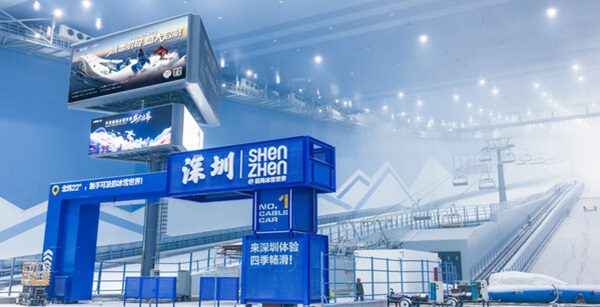
Forget the clichés about Shenzhen being another tech city in the Pearl River Delta. On 29 September, the city pulled off a stunt worthy of a Bond villain: it unveiled HUAFA SNOW BONSKI, a vast ski dome that could make Switzerland feel insecure. At 100,000 square metres, this ice-coated cathedral is now billed as the world’s premium ski dome. Not bad for a place better known for steamy summers than frosty pistes.
Slopes That Mean Business
Sceptics might dismiss an indoor ski slope in southern China as a theme-park gimmick. But BONSKI isn’t playing. It boasts five professional slopes with 1,569 metres of runs, a vertical drop of 83 metres, and gradients up to 18 degrees. The longest single run stretches an impressive 463 metres, enough to let you build up speed and pride before tumbling spectacularly.
BONSKI has achieved the golden seal of legitimacy: its advanced and intermediate slopes meet International Ski Federation (FIS) standards. Translation? This isn’t just somewhere for locals to practise snowplough turns. It’s a venue capable of hosting international slalom and alpine competitions. The Greater Bay Area, already famous for shipping containers and financial services, now has a shot at staging World Cup ski events.
A Spectacle of Snow and Showmanship
The launch itself was less ribbon-cutting, more Broadway on ice. A snow show combined jaw-dropping stunts, immersive visuals, and audience participation. The applause wasn’t just polite — it rolled on like a victory lap, underlining that Shenzhen wasn’t merely opening another attraction. It declared a new chapter: year-round snow sports in a subtropical metropolis.
One couldn’t help but notice the symbolism. Shenzhen, the city that grew from a fishing village to a global powerhouse in four decades, is now muscling into winter sports, traditionally the domain of Europe and North America. This is China flexing its soft power through snow.
Families Welcome, Not Just Olympians
Of course, BONSKI isn’t all about medals and moguls. Families are firmly in the crosshairs. A 4,000-square-metre Ice & Snow Wonderland offers 14 interactive attractions, from parent-child activities to junior competitions. It’s a clever move: train the next generation while giving mums and dads a reason to return.
And for those who’d rather watch than wobble, the dome delivers cultural experiences and leisure zones. Think “snow sports plus athletics plus cultural tourism” — a hybrid model that ensures BONSKI is as much about selfies, hot chocolate, and themed experiences as it is about carving turns.
Strategy on Ice
Behind the snow cannons lies strategy. BONSKI positions itself as a comprehensive international snow sports operator, blending professional training, school partnerships, and competition hosting. It’s part of a broader play to energise the cultural and sports economy across the Greater Bay Area, which conveniently includes the cash-rich cities of Hong Kong, Macau, Guangzhou, and Shenzhen.
This is not just about giving local families something novel to do on weekends. It’s about talent cultivation, industry growth, and tourism drawcards. And if that sounds like jargon, think of it this way: BONSKI wants to mint future champions while filling hotel rooms and restaurants.
A Bold Bet Pays Off?
Will Shenzhen’s snow gamble succeed? If history is any guide, the answer leans yes. China has a knack for building big, making it pay off through sheer scale. BONSKI will no doubt host its share of FIS-sanctioned competitions, pull in curious tourists, and give local youth a shot at winter glory.
For now, though, it’s enough to marvel at the audacity. Shenzhen, a city of skyscrapers and subtropical heat, now boasts a world-class ski dome. Somewhere in Switzerland, a ski resort manager is pouring another glass of schnapps, nervously checking bookings.
By Charmaine Lu