
The Pfister Hotel – Milwaukee, WI
The vision of businessman Guido Pfister and his son, Charles, this historic Milwaukee gem opened in the height of the Gilded Age in 1893. It was the most lavish hotel of its time, costing nearly $1 million to construct, and was aptly referred to as “The Grand Hotel of the West.” The luxurious three-story lobby; marble staircases; modern fireproofing and in-room thermostats (which were cutting edge for the time) all contributed to guests from around the country flocking to stay there, including U.S. presidents, tycoons of industry, and dignitaries: a trend that continues today. The Pfister still boasts the largest collection of Victorian art of any hotel, while the property itself has been meticulously cared for and renovated over its 132 years, showing some of the finest elements of Romanesque Revival architecture. For guests seeking the most historic stay possible, the newly-renovated Pfister guest rooms (located in the historic side of the hotel) are most reminiscent of the Gilded Age era. Head to the lobby lounge and settle in by the opulent fireplace for an 1893 Old Fashioned and piano music to really feel like a Van Rhijn.
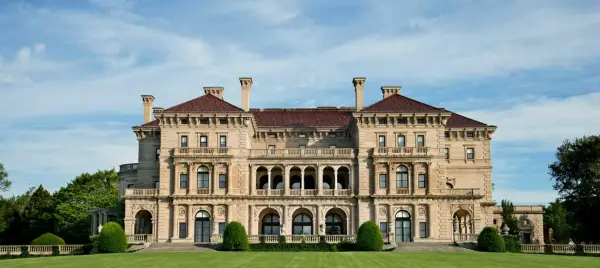
Newport Mansions – Newport, Rhode Island
The Gilded Age filmed much of the show at Newport’s mansions, which travelers can actually visit and tour.
-
The Elms did double duty as the Russell family’s Newport cottage as well as places in their New York mansion, including the kitchen where the staff gathers and gossip.
-
The Marble House Dining Room, where Bertha Russell hosted a dinner for the Duke of Buckingham; Consuelo Vanderbilt’s bedroom, which was George Russell’s room in the show; and Alva Vanderbilt’s bedroom, which inspired the set design for Bertha’s room.
-
The Chateau-sur-Mer Dining Room and Ballroom, used for Mrs. Fish’s doll tea party; the distinctive Stair Hall seen when Mrs. Russell calls on Mrs. Fish; and upstairs rooms used by Agnes and Oscar van Rhijn.
-
The Breakers Billiard Room, where railroad tycoon George Russell and Alderman Patrick Morris schemed over a game.
-
The Breakers Music Room, where guests danced during Gladys’ debutante ball and Bertha had her first social triumph.
Delmonico’s – New York City
Delmonico’s, America’s first fine-dining restaurant, played a significant role in this season’s The Gilded Age, and for good reason—it was one of the most iconic restaurants of its time (and still is!). Located in its original building at the corner of Beaver and William Streets in NYC’s financial district since 1837, Delmonico’s has hosted a wide array of culinary enthusiasts and notable patrons, including Abraham Lincoln, Mark Twain, Charles Dickens, and J.P. Morgan. The restaurant is famous for dishes like Eggs Benedict, Baked Alaska, Chicken a la Keene, Lobster Newberg, and Delmonico Steak. It was also the first to use the term “restaurant,” the first to publish a cookbook, and the first to serve women sitting at their own tables. Delmonico’s predates the Statue of Liberty, the Brooklyn Bridge, the Flatiron Building, and Grand Central.
HOTEL DU PONT – Wilmington, DE
Steeped in Gilded Age grandeur, HOTEL DU PONT is an iconic beacon of history and elegance in the heart of downtown Wilmington, DE. This twelve-story Italian Renaissance masterpiece opened in 1913, the result of a two-and-a-half-year construction effort that brought together the talents of French and Italian artisans. Their meticulous handiwork—seen in the carved woodwork, gilded flourishes, and hand-painted details—embodies the opulence and artistry of the era. From imported European chandeliers and soaring ceilings to sweeping staircases and the glittering Gold Ballroom, every inch of the hotel reflects the drama and decadence of a bygone golden age. This iconic Grande Dame has been artfully reimagined for today’s discerning traveler, blending Gilded Age glamour with contemporary sophistication – think soaring ceilings with hand-carved details, original terrazzo floors, silk-paneled walls, and dramatic crystal chandeliers. HOTEL DU PONT evokes a timeless luxury that never goes out of style.