
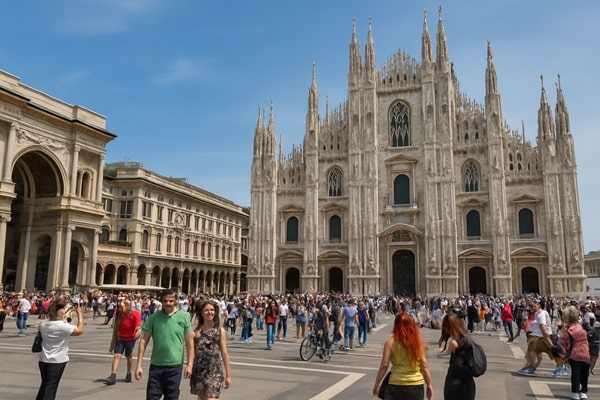
For years, we’ve been told that when tourists descend in droves, locals inevitably pack up their patience and mutter about lost tranquillity, inflated rents, and too many rolling suitcases rattling across cobblestones. Yet, Milan’s fresh and rather cheeky report suggests that this familiar lament is not so clear-cut after all.
The first integrated white paper on overtourism and quality of urban life in Milan, produced by The Data Appeal Company – Almawave Group in collaboration with Doxa, reveals that Milan’s busiest neighbourhoods are not groaning under the weight of travellers. In fact, in many cases, residents in tourist-heavy areas are reporting a higher quality of life than their less-visited neighbours.
One might almost say that Milanese life, far from wilting under tourist footfall, is positively thriving.
The Numbers Tell a Different Story

The study combined big data analytics with boots-on-the-ground perceptions, surveyed more than 500 residents and drew upon 130 digital sources. It was discovered that:
-
75% of Milanese value the city’s essential services.
-
74% give a hearty nod to the cultural offerings.
-
63% even say tourism makes the city more dynamic.
Of course, not everything is sunshine and Aperol Spritz. 77% point to rising prices as the dark side of tourism, while 59% feel their quality of life has dipped in the last three years, though they largely blame costs of living and insecurity, rather than tourists snapping selfies outside the Duomo.
Interestingly, only 32% think tourism erodes Milan’s cultural identity, which puts paid to the notion that locals are ready to barricade the piazzas against visitors.
The Neighbourhood Storybook
The research painted Milan not as one monolithic “tourist city” but as a patchwork quilt of experiences:
-
Municipality 6 (Barona, Lorenteggio, Navigli): Tourists come for the canals and nightlife, locals stay for the leafy spaces and urban renewal. Here, tourism and happiness dance in step.
-
Historic Centre: Tourist flows are at full throttle, yet services and socioeconomic strength keep livability high. The irony? It’s the heart of “peak tourism, ” yet nobody’s running for cover.
-
Città Studi, Lambrate, Porta Venezia: A university and cultural magnet, but congestion and lack of greenery temper residents’ enthusiasm.
-
Municipality 8: Low tourist numbers and high resident satisfaction prove that good urban life depends on more than just how many guidebooks point your way.
Voices from the Ground
“This work was born from the need to observe urban tourism in a more detailed and realistic way,” said Mirko Lalli, CEO and Founder of The Data Appeal Company Almawave Group. “The relationship between tourism and quality of life is not automatic and varies from district to district. Our model, which integrates objective data with residents’ voices, offers policymakers a replicable tool to manage tourism flows more sustainably across European cities.”
Meanwhile, Susanna De Luca, Senior Research Manager at Doxa, added: “For us, this project was an opportunity to combine quantitative and qualitative approaches, integrating data-driven insights with residents’ direct voices. Beyond the methodology, the real value lies in questioning a dominant narrative: in Milan, at least in some neighbourhoods, tourism is not perceived as a burden, but as a factor that can coexist—even positively—with quality of urban life.”
The Wider Lesson
Milan’s white paper may unsettle the global chorus of critics chanting that “overtourism equals misery.” Instead, it suggests a subtler truth: tourism is neither hero nor villain. Context, management, and urban design decide whether residents grumble or grin.
Policymakers across Europe—grappling with Venice’s cruise ships, Barcelona’s crowded Ramblas, or Amsterdam’s boozy stag parties—may find that Milan’s approach offers a fresh template. Marry complex data with local voices; the harmony may surprise even the most hardened sceptics.
The study is freely available here: Milan White Paper on Overtourism, for the full report and to dive deeper into the data.
Final Word
Milan has done what Milan does best: turned a cliché on its head, dressed it up in fine tailoring, and walked it confidently down the catwalk of ideas. The so-called “overtourism myth” may not be dead, but in Milan at least, it’s been thoroughly ruffled, reshaped, and politely shown the door.
By Karuna Johnson