

Trip planning, that age-old ritual of juggling brochures, price comparisons, and hopeful Googling, has been given a startling makeover. Adobe has released figures showing that visits to US travel websites from generative AI sources surged a jaw-dropping 3,500% year-on-year in July 2025. Yes, you read that correctly. Americans no longer rely solely on guidebooks or friendly neighbours; they ask machines to be their holiday planners.
The rise of the AI travel assistant
Generative AI, once the preserve of tech enthusiasts, is fast becoming a mainstream companion for anyone looking to turn a vague desire for “a nice getaway” into a fully-fledged itinerary. Adobe’s Digital Insights team crunched data from more than 8 million visits to US travel sites, backed by a survey of 5,000 consumers. The result is that nearly one-third of Americans (29%) use AI services to plan their travels.
The most popular tasks? I have not booked flights just yet, but I am researching. 53% of respondents said they relied on AI to uncover local attractions, restaurants, hidden gems and even the best times to visit. Travel inspiration (47%) and transport planning (45%) followed close behind, with budget management (33%) and itinerary building (37%) rounding out the list.
Simply put, AI is evolving into a tour guide, concierge, accountant, and PA rolled into one, all without the tip.
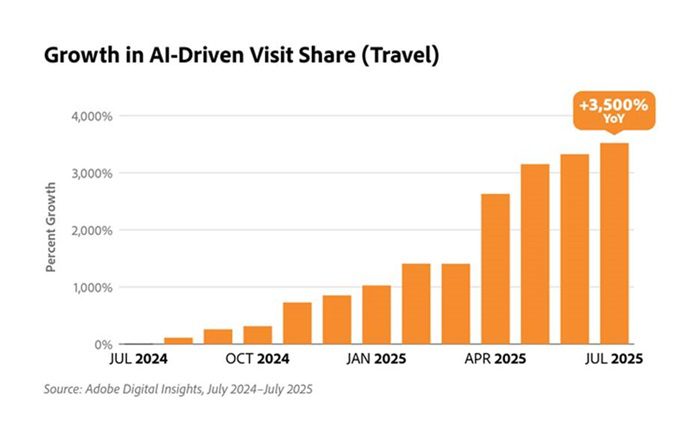
Engagement up, bounce rates down
The data suggests travellers arriving at websites via generative AI are, dare one say, more serious about their holidays. Compared with other traffic sources — paid search, affiliates, social media and the like AI-referred visitors spent 36% longer on sites, clicked through to 7% more pages, and bounced away 44% less often.
In other words, when a chatbot nudges you towards a travel site, you’re less likely to bolt at the first sight of prices. Instead, you settle in, look around, and maybe start imagining yourself on that Greek island or in that Hawaiian resort.
“Of those who used AI for trip planning, 88% said it improved their booking and travel experiences,” Adobe notes. Millennials and Gen X, often accused of killing everything from breakfast cereal to department stores, show surprising enthusiasm here: 89% and 91% said AI enhanced their planning.
Conversion gap: mind the narrowing distance
Of course, the million-dollar question (or perhaps billion-dollar in tourism terms) is whether AI leads to bookings. Historically, it hasn’t been stellar. AI-driven visitors were once 86% less likely to convert than their non-AI counterparts. But in July 2025, that gap shrank dramatically to 47%, proving that while AI may start as a research tool, it’s rapidly gaining consumers’ trust when clicking “confirm purchase.”
The narrowing conversion gap suggests travellers are warming to the idea of completing a booking immediately after chatting with their AI assistant. That could spell big changes for online travel agencies, airlines, and hotels, all of whom must now rethink how they engage with customers at the digital coalface.

A redefined relationship between traveller and industry
For travel businesses, these trends aren’t just a curiosity but a flashing neon sign. If AI is where research begins, companies must ensure their information, offers, and customer experience are AI-friendly. Future-facing travel providers will ensure their deals surface seamlessly in generative AI chats, complete with personalised recommendations.
“Generative AI isn’t just a novelty anymore,” observed Vivek Pandya, Director of Adobe Digital Insights, whose division publishes digital marketing and e-commerce research. “It’s becoming an integral part of the travel planning journey, and businesses will need to adapt if they want to remain relevant.”
A glimpse of what’s ahead
Looking back, one could argue travel planning hasn’t changed all that much since the golden days of Thomas Cook. Once a human agent guides you through the options, an AI chatbot does the heavy lifting. The tools differ, but the impulse is the same: travellers want guidance, clarity, and reassurance before they part with hard-earned dollars.
The difference today is scale. With AI handling millions of queries simultaneously, the industry faces unprecedented opportunity and risk. Get it right, and you’ll have informed, engaged customers ready to book. Get it wrong, and your competitor’s chatbot will be too happy to whisk them away.
The message is simple for consumers: embrace the convenience, but don’t switch off your common sense. After all, even the cleverest AI can’t tell you whether you’ll enjoy that seafood restaurant on the Amalfi Coast; only experience can tell.
By Sandra Jones