
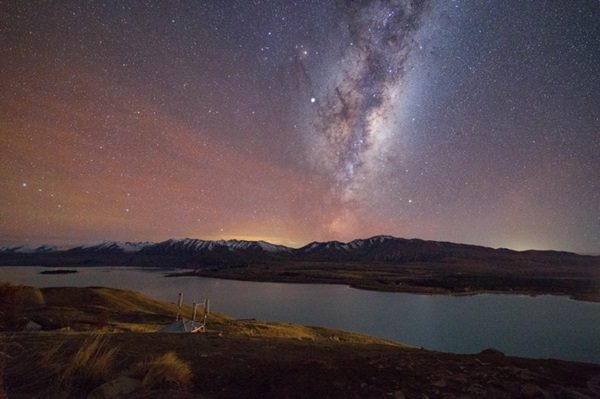
Australia has its share of distractions, footy finals, property prices, and the occasional brawl over who invented the flat white. But across the Tasman, the Kiwis have decided that the real gold lies not in the hills or rivers but written across the heavens. And the best bit? They’re inviting us over to take a peek.
On 7 September, a lunar spectacle is set to light up New Zealand’s famously inky skies, and Australians are being told to pack a jumper, a sense of wonder, and perhaps a thermos. Welcome to astrotourism, the latest craze in travel—where the stars aren’t just twinkling; they’re paying the bills.
Tekapo’s Dark Sky Project: still dazzling after 20 years
For those who think stargazing is just lying on the grass with a blanket and a bottle of shiraz, Tekapo has news for you. This winter marks 20 years of the Dark Sky Project at Takapō (Tekapo), and it has elevated stargazing into something approaching spiritual theatre.
Perched high on Mount John, 1,029 metres above sea level, visitors are treated to a guided cosmos tour through serious telescopes—not your backyard Bunnings variety, but the sort that make Saturn’s rings look close enough to wear.
What makes the experience uniquely Kiwi is the weaving of Ngāi Tahu Māori star lore with modern science. As Victoria Campbell, General Manager and Ngāi Tahu astronomer, puts it:
“Ngāi Tahu Tourism is very proud to be associated with the pioneers of astrotourism. I’m excited that twenty years on, we’re still sharing their love of the night sky along with mātauranga Māori and our traditional Ngāi Tahu stories about whetū (stars).”
It’s an intoxicating cocktail: a dash of science, a splash of culture, and a generous serve of awe. No wonder 45,000 visitors a year head skyward in Tekapo.
Lodges that serve stars with hot chocolate
Of course, this is New Zealand—where luxury is no longer about marble foyers but about how close your bathtub gets you to the Milky Way.
Take the Headwaters Eco Lodge in Glenorchy. Here, guests dine on a chef’s feast, sip hot chocolate, and then enter the Tāhuna Glenorchy Dark Sky Sanctuary (one of just 23 worldwide). It’s half astronomy, half indulgence, with a sprinkling of marshmallows on top.
Further south, the Fiordland Eco Retreat at Lake Te Anau promises something even more decadent when it opens in Spring 2026. With its outdoor baths, stargazing windows, and astronomy sessions led by a certified Dark Sky Ambassador, it sounds less like a holiday and more like an interstellar spa. Oh, and don’t pack the kids, it’s adults only. The stars, it seems, prefer quiet company.
Why it matters
What’s unfolding is more than just tourism dressed up with telescopes. It’s a uniquely New Zealand story: an elegant weaving of indigenous culture, natural wonder, and sustainable luxury. The Māori connection grounds it in history, the science makes it compelling, and the lodges ensure visitors tell their friends (and post their photos).
In an age where travellers crave authenticity as much as indulgence, astrotourism is proving a winning combination. The result is travel that makes you pause, look up, and remember how small we all are under the same stars.
Final word
So, if you’re tired of squinting at your phone or dodging city light pollution, September is your chance to trade traffic for telescopes. The Kiwis have monetised the Milky Way and are good at it.
Australians may yet discover that the most dazzling souvenirs aren’t duty-free bargains at Auckland Airport but the memories you bring back after a night under New Zealand’s spectacular skies.
By Karuna Johnson