
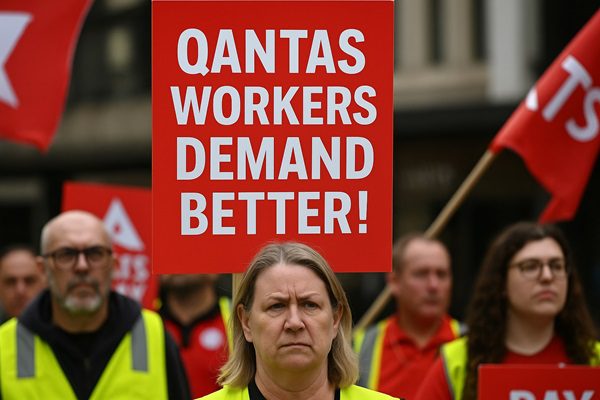
There’s turbulence brewing in the Qantas cabin, and it’s not the weather this time. The Australian Services Union (ASU) has fastened its seatbelt, flicked on the “no-nonsense” sign, and called a nationwide electronic vote for Qantas members to decide whether the airline’s latest enterprise agreement offer deserves to land or be sent back to the hangar.
The vote opens this Thursday, with the timing no coincidence. It neatly coincides with Qantas’s preliminary financial results — numbers that will once again underline the airline’s robust profits. And while shareholders might be happily clutching their dividends, the staff who keep the airline aloft are asking a somewhat more grounded question: when will some of that fortune finally trickle down to them?
A First for Frontline Voices
This marks the first formal opportunity for frontline Qantas staff — the check-in agents, call centre workers, and freight handlers who hold the whole flying circus together to weigh in directly on the deal that’s been inching its way through negotiations since February.
ASU Assistant National Secretary Scott Cowen was in no mood for polite niceties when he spoke.
“Qantas has already reported a profit of almost $1 billion for the first half of this year. It’s time the airline invested in its frontline staff — the people who keep this airline running — not just its shareholders.”
He went further, calling out what he sees as the elephant in the departure lounge: gender pay disparities.
“This isn’t just about a pay rise; it’s about addressing the structural issues that have left women workers at Qantas undervalued and underpaid. Our members deserve real change, not tokenistic initiatives.”
A History of Profits Before People
Mr Cowen didn’t spare the airline’s blushes when referencing its recent rap over the knuckles by the Federal Court.
“Last week’s Federal Court decision shows Qantas has clearly learned nothing from its ongoing profiting off the backs of workers. This is a company that continues to make short-term decisions, cutting corners and driving down job quality to maximise profits at the expense of its workers and customers.”
These are strong words, but the union believes its timing is right. With the airline flying high in the black again, the ASU sees no reason why Qantas can’t invest in better pay, more humane rosters, and fixing long-standing inequities.
The Vote That Could Shift the Flightpath
The electronic ballot will remain open until Wednesday, 3 September. Depending on how members cast their votes, the outcome could signal either cautious acceptance or the start of a stronger, more combative bargaining phase, including the possibility of protected industrial action.
Mr Cowen summed it up bluntly:
“Our members are voting on whether this offer is near-acceptable, or if we need to pursue a stronger course of action. Real change must be embedded into workplace agreements, because words and good intentions alone are simply not enough.”
A Test for Qantas’s Reputation
This vote is more than just another industrial skirmish for an airline that has spent the past year trying to repair its public image after courtroom dramas, customer complaints, and service mishaps. It’s a test of whether Qantas can finally pivot from a “profits first” mantra to something more sustainable: genuine investment in the people who deliver the service.
Airlines, after all, are built on more than fleet upgrades and glossy advertising campaigns. The staff who greet passengers at the desk, lift luggage, answer phones, and keep operations humming at 2 am carry the real load. Ignore them long enough, and no amount of frequent flyer points will mask the turbulence ahead.
The Bottom Line
As the vote opens, one thing is clear: Qantas’s frontline workers are no longer content with polite applause and pats on the back. They want structural reform, fair pay, and equity built into the airline’s DNA. The ASU has delivered the ballot; the rest, quite literally, is now in the workers’ hands.
By Sandra Jones