Dubai has a certain amount of electricity in May, and it is not just the air conditioning battling the Gulf heat. At this year’s Arabian Travel Market (ATM) 2025, the conversations crackled with a different kind of energy: Artificial Intelligence. You could almost hear the algorithms humming as industry heavyweights debated whether AI is the industry’s greatest blessing… or a digital Trojan horse threatening to nick the soul out of travel.
The numbers, at least, are impressive. A fresh report by Tourism Economics found that six out of ten UAE travellers already trust AI to plan their trips. That’s more than anywhere else, outpacing the global average of 48%. And this isn’t just picking a hotel or checking the weather, we’re talking complete itineraries, from flights to fine dining, curated by silicon brains that never sleep.
When Robots Pack Your Bags
If you think this is some distant future, think again. Nearly 60% of travellers in the Middle East have already asked AI to plan a trip, and 21% had their last getaway shaped by machine learning. The selling point? Hyper-personalisation. Not the “We see you booked Paris, here’s a croissant” kind, but detailed itineraries crafted around your quirks, whether you’re a Michelin-chasing foodie or the sort who thinks hiking is just an excuse to get lost with dignity.
Travel companies are salivating at the efficiency. AI doesn’t take lunch breaks, doesn’t get jet lag, and can handle thousands of requests simultaneously without so much as a sigh.
ATM 2025: Innovation Meets Old-School Charm

Human Centric Tech changing the face of trave tech session at ATM
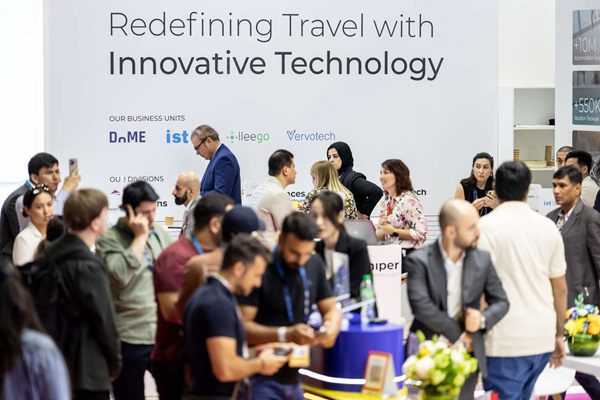
This year, the ATM Travel Tech halls could have passed for a Silicon Valley expo — if Silicon Valley had better coffee and the occasional oud fragrance wafting past. The meeting point between hospitality, technology, and the MICE sector (that’s Meetings, Incentives, Conferences, and Exhibitions for the uninitiated) was buzzing with one question: can we have all this shiny new tech without losing the handshake, the smile, the warm “Welcome back, sir” from someone who remembers your last visit?
Amy Read, Vice President of Innovation at Sabre Hospitality, offered a pearl of wisdom:
“It is important to recognise that human connection is at the core of hospitality. When we think about innovation within hospitality, we try to find ways that amplify those key moments, rather than replace them. We want to free up staff time so that they can engage in more meaningful interactions.”
Translation? AI can fetch your boarding pass in milliseconds, but it can’t notice the travel-weary slump of your shoulders and offer you a cold drink without being asked.
Concierges of the Future — and the Present
Take SynXis Concierge AI, Sabre’s latest party trick. It uses generative AI to handle guest queries instantly, 24/7, delivering detailed, accurate answers, and — if the marketing is to be believed, more consistent than some human staff. But here’s the kicker: it’s designed to free those humans to do what they do best, the bits that make hospitality more than logistics.
The UAE, never one to shy away from a tech showcase, already has its attractions running on AI charm. Miral’s Majd Al, a digital concierge with a name as elegant as its code, operates at Yas Bay Waterfront and Ferrari World Yas Island. Want thrill rides, dinner, and a gentle evening stroll mapped to your preferences? Majd Al will plot your evening before you’ve shaken the sand from your sandals.
The Human Blueprint Behind the Code
Yet for all the AI wizardry, smart operators know that machines are only as good as the human wisdom baked into them. Saudi travel platform Almosafer has taken a co-creation approach, building tools in direct response to customer frustrations. Over at Expedia TAAP, the tech is shaped by travel agents themselves, meaning the gadgets are practical rather than just impressive in a pitch deck.
And then there’s the MICE sector — the corporate end of travel that quietly moves billions. The global meetings and events industry is set to hit USD 945 billion by 2025 and an eye-watering USD 2.3 trillion by 2032. Here, AI isn’t just helpful, it’s transformative: sourcing venues in seconds, translating speeches in real time, and tailoring agendas so precisely that every delegate feels the event was made for them.
Warning: Handle With Humanity

Danielle Curtis-Exhibition Director ME ATM.
But if there was a unifying theme at ATM 2025, it was caution. Speakers across the board urged the industry not to swap authenticity for automation. A personalised itinerary may delight, but it’s the unexpected conversation with a hotel manager or the unplanned detour suggested by a driver that often becomes the highlight of a trip.
Danielle Curtis, Exhibition Director ME at ATM, put it succinctly:
“When it comes to travel and tourism innovations, the most effective technologies are those that amplify human interactions, improve efficiency and respond directly to customer needs.”
The message? AI should be the sous-chef, not the chef. The supporting act, not the headliner.
Next Stop: ATM 2026
This year’s ATM Travel Tech was the biggest yet, with over 26% more products on show than the last edition. And with ATM 2026 already dated for 4–7 May, the industry’s eyes are firmly on what comes next. Expect even sleeker systems, more intelligent algorithms, and more talk about “immersive experiences”, though hopefully still served with authentic human hospitality.
Because if AI is the compass, people’ll always choose the destination. And as any traveller worth their luggage tag knows, it’s not the route that makes the journey memorable — it’s the company.
By Stephen Morton