
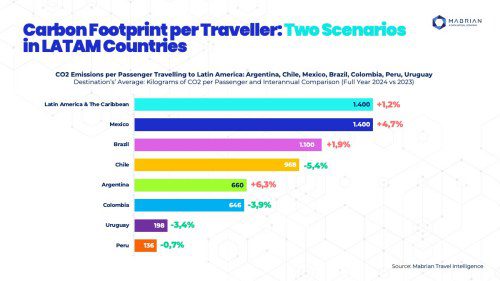
The analysis of the carbon footprint per passenger helps destinations understand and visualise their environmental impact, gaining true strategic value when combined with other tourism impact indicators, such as travellers’ spending patterns. As highlighted by Mabrian in this study, for Latin American destinations, tracing CO₂ emissions from travellers is becoming a fundamental tool for designing competitive and efficient air connectivity strategies that drive sustainable tourism development
Barcelona (Spain); July 31st, 2025.
Streamlining and planning routes on long-haul flights with efficiency criteria can contribute to reducing the carbon footprint generated by travellers globally, as shown by Mabrian, the global tourism intelligence and strategic advisory partner, after analysing the CO2 emissions per passenger generated by global air connectivity networks for seven Latin American destinations.
The study compares the carbon footprint per passenger across the main destinations in Latin America — Argentina, Chile, Mexico, Brazil, Colombia, Peru, and Uruguay — which together accounted for 98% of international arrivals to the Latin American and Caribbean region in 2024, according to UN Tourism data. Based on Mabrian’s analysis, domestic and international flights in these seven countries generated a total of 38.3 million tons of CO₂ during 2024, representing a +5.6% increase compared to the previous year. For reference, CO2 emissions in the Southern European region, which includes destinations such as Spain, Italy, Greece, Portugal, and Croatia, increased by 14% in 2024, totalling 29.9 million tons of CO2.
The carbon footprint per passenger is an indicator developed by Mabrian that measures the average kilograms of CO₂ emitted by each air traveller arriving at a destination. This ratio is calculated using the International Civil Aviation Organization (ICAO) methodology, which factors in cabin class, the passenger‑to‑cargo ratio, and the load factor (percentage of occupied seats) for each route group.

“The carbon footprint per passenger only gains true meaning when viewed alongside other indicators of traveller impact on a destination, such as the level and distribution of spending,” explains Carlos Cendra, Partner and Marketing & Communications Director at Mabrian. “For destinations, the carbon footprint should not be treated solely as a quantitative metric; above all, it must be a traceability tool for designing more sustainable, efficient, and profitable connectivity strategies.”
“Efficient routes,” the key to reducing the carbon footprint per passenger
The main conclusion of this analysis is that the emissions ratio per visitor to the analysed countries decreases thanks to the impact of long‑haul routes, which over the past 12 months have managed to significantly lower CO₂ emissions.
“Several factors contribute to these air routes achieving a lower carbon footprint per passenger, such as the renewal of fleets with more modern and efficient aircraft, optimised load‑factor planning, and the introduction of larger aircraft. All of this responds to airlines’ efforts to make their routes more profitable—either by increasing revenue or reducing costs, particularly fuel costs—which, in turn, helps cut their carbon footprint,” explains Cendra.
The data reveal two clear scenarios: countries where the carbon footprint per passenger has fallen compared to the previous year, such as Chile (-5.3% on average), Colombia (-3.9%), Uruguay (-3.4%) and Peru (-0.7%); and destinations where CO₂ emissions per visitor have risen, such as Argentina (+6.3%), Mexico (+4.7%) and Brazil (+1.9%). The breakdown of key source markets for each destination further illustrates the effect of these “efficient routes” in reducing CO₂ emissions per passenger.
The influence of long-haul routes is particularly evident in Chile, the Latin American destination where, among the seven countries analysed, the carbon footprint per passenger decreases the most in 2024. This improvement is driven by routes that, while generating a significant volume of CO₂ emissions overall, have become more efficient compared to the same period last year. Notable examples include flights from Australia (-7.9% vs. 2023), New Zealand (-2.3%) and Spain (-0.2%).
Colombia shows a similar trend: two of its long-haul routes with the largest carbon footprints, Turkey and Germany, have reduced their emissions in one year by -18.8% and -10.7% respectively. A comparable scenario is observed in Uruguay, where emissions on flights from Colombia have dropped by -12.1%, those from Spain by -4.1%, while emissions from the United States and Panama remained stable.

Reducing the carbon footprint is essential for advancing sustainability in tourism. According to the World Travel & Tourism Council (WTTC), 6.5% of global greenhouse gas emissions come from the tourism industry, its value chain, and international transport networks—and 37% of those emissions are linked to passenger transport. Aviation alone plays a key role, as highlighted by the Air Transport Action Group (ATAG) in its 2024 edition of Aviation Benefits Beyond Borders: 80% of aviation CO₂ emissions are generated by flights over 1,500 kilometres, routes for which no transportation alternative exists. Furthermore, 2.05% of all CO₂ emissions caused by human activity come from air transport.
“Our data proves that, despite the challenges and technical complexities, both the airlines operating in Latin America and the region’s destinations are aligned with this commitment, although there is still room for improvement,” emphasizes the spokesperson for Mabrian, part of The Data Appeal Company – Almawave Group. “The next step is to strengthen the capacity of destinations to operate using these types of indicators and to raise awareness of how data intelligence can drive sustainability, for example, developing routes and connectivity strategies that that factor in not only growth and competitiveness but also other impact parameters that support sustainable development,” he concludes.