
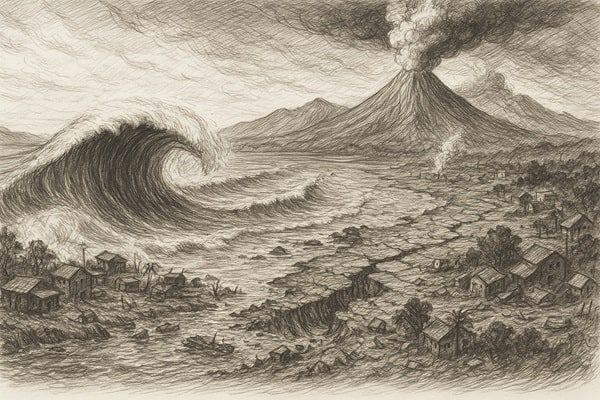
Russia’s Far East shudders, 44 nations go on alert, and the Earth proves she’s still boss.
Well, if anyone needed a reminder that Mother Nature has a flair for the dramatic, she served up a rather spine-jangling one this morning—an 8.8 magnitude earthquake off Russia’s Kamchatka Peninsula, shaking not just the rugged Far East but nerves across 44 countries and setting off a chain reaction of tsunami alerts that had half the Pacific skipping breakfast.
Let’s call it what it is: terrifying, awe-inspiring, and oddly humbling.
At precisely 7:42 am Kamchatka time—while most were likely contemplating coffee, not catastrophe—the ground beneath the Okhotsk Sea shuddered worthy of Poseidon himself. And then it rumbled. And didn’t stop. The tectonic plates performed their version of Swan Lake for nearly two minutes, only with less grace and considerably more menace.
The result? Seismic waves rippling across the Pacific like gossip at a family reunion—reaching Japan, the Philippines, Indonesia, Alaska, Hawaii and beyond. If your phone wasn’t buzzing, your coastal radio probably was.
Meanwhile, and just for good measure, one of Kamchatka’s volcanoes decided it was a perfect moment to throw its tantrum. Eyewitnesses in Petropavlovsk-Kamchatsky reported a plume of ash rising like a ghost over the snow-dusted hills of Klyuchevskaya Sopka—Russia’s highest and most temperamentally active volcano.
In the words of an emergency services officer, “This is not a drill. This is very real.” You don’t say.
Authorities in Russia declared a state of regional emergency before the coffee had cooled, and the Ministry for Civil Defence was swift to issue reassurances—which, in typical Russian understatement, described the quake as “significant.” That’s a bit like calling a cyclone “breezy”.
By mid-morning, tsunami warnings had been broadcast in 44 nations. Across Japan, residents of Miyagi and Fukushima were ordered to higher ground. In the Philippines, coastal towns from Ilocos to Davao activated emergency sirens. Hawaii’s Pacific Tsunami Warning Centre didn’t mince words, calling the event “an unfolding high-risk seismic crisis.”
The Pacific’s blue serenity suddenly took on a sinister shimmer from Manila to Maui. Ferry operators turned tail. Cruise ships pivoted mid-route. Island resorts rushed to reassure travellers (and cancel beachfront yoga). No one, it seemed, was breathing easy—except perhaps the volcano.
Speaking to TASS, Russian geologist Dr Mikhail Grushenko remarked with admirable calm, “This may be the largest earthquake in the Kamchatka region since 1952.” That one generated a tsunami that reached Peru. So yes, comparisons are grim and historically significant.
Thankfully, no confirmed deaths have been reported at the time of writing, but the situation remains as fluid as the Pacific itself. Satellite images hint at coastal damage along remote sections of Kamchatka, with small fishing villages feared to be hardest hit. Communications remain patchy, with icy winds and ash clouds doing little to help.
Meanwhile, Australia’s Bureau of Meteorology clarified that while there’s no tsunami threat to our coastline, the region is “under observation.” Translation: don’t unpack the emergency go-bag just yet.
This isn’t just a geological event—it’s a reminder that the Pacific Rim isn’t called the Ring of Fire because it sounds catchy. It’s a bruiser of a belt, and today, it delivered one hell of an uppercut.
The real question now: what comes next?
Volcanologists are monitoring Kamchatka’s restless peaks for any signs of escalation. Tsunami sensors from Guam to Tahiti remain on edge. Emergency services across Southeast Asia are keeping their evacuation protocols in warm-up mode. And somewhere, in a Tokyo command centre, a seismologist has just requested their third espresso.
There’s a strange poetry in it all. The raw, terrifying choreography of plate tectonics, the billowing plume of volcanic rage, and the crackling radio static of global coordination—it’s ancient and modern all at once.
But it’s also deeply human. From the Russian sailor who dashed inland as the docks buckled beneath his feet, to the Balinese receptionist comforting guests with trembling hands, to the Alaskan child woken by a siren and wrapped tight in a parent’s embrace—this is how the Earth reminds us: we are small, and she is not done with us yet.
So while the official damage assessment continues, and world leaders issue their obligatory condolences, let us not forget the oldest lesson: the Earth moves when she wants to. And when she does, all we can do is hang on, help each other, and maybe—maybe—respect her a little more.
By Sandra Jones