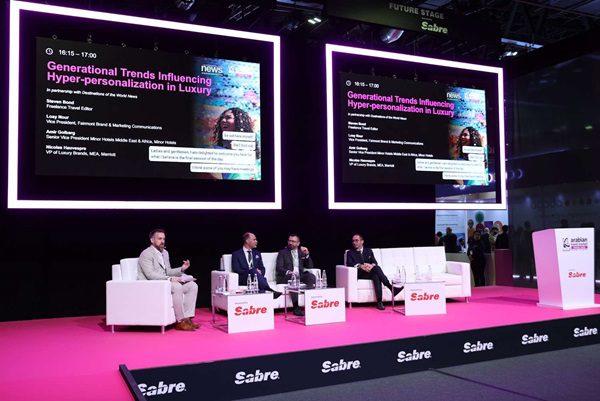
Once upon a not-so-distant past, luxury in hospitality meant thread count, chandeliers, and being called “sir” or “madam” with robotic precision. But according to the luminaries gathered at Arabian Travel Market (ATM) 2025, that tired script has been torn up and flambéed with the same flourish as a Crêpes Suzette at a Ritz-Carlton brunch.
Welcome to the age of hyper-personalisation—where your pillow preference, spa playlist and perhaps even your morning espresso order are anticipated before you’ve even unbuckled your seatbelt. And if that sounds like something from a Black Mirror episode, don’t worry—it’s luxury hospitality’s new reality and putting dollars directly into the till.
A Trend With Teeth
At ATM 2025 in Dubai, executives from Minor Hotels, Fairmont and Marriott sang in glorious harmony on one key refrain: the future of luxury travel is not about more opulence, but more meaning.
The annual ATM Travel Trends Report, compiled in partnership with Tourism Economics, left little doubt. A resounding 85% of hoteliers now see personalisation as a critical driver of commercial value. Even more eye-watering? Tailored experiences are proven to boost revenue by up to 5%. It’s no wonder the global customisation and personalisation in the travel market is forecast to hit a cool US$620.71 million by 2032, according to Future Market Insight Inc.
This is not simply the warmed-up towel of trendiness. This entirely reimagines how the luxury guest journey is designed, curated, and monetised.
The Art of Anticipation
Nicolas Hauvespre, Vice President of Luxury Brands for Marriott in the Middle East and Africa, led the charge. For him, hyper-personalisation is much more than greeting guests by name or ensuring the minibar is stocked with their favourite kombucha.
“When it comes to hyper-personalisation,” Hauvespre explained, “this goes far beyond traditional service. It’s about creating something highly tailored and curated through leveraging technology and building on your culture, so you can develop that anticipatory service and meet both the explicit and unspoken needs of your guests.”
That last bit—“unspoken needs”—separates the amateurs from the artisans.
Technology Meets Human Touch
Of course, AI is the silent partner in this dance of delight. From intelligent chatbots that predict preferences to AI-assisted room settings that adjust lighting and temperature based on guest history, the digital realm enables bespoke service levels that once required an army of attentive butlers.
But don’t think hospitality has gone fully robotic. The panel quickly pointed out that human warmth—genuine smiles, cultural connection, the occasional knowing wink—is still the secret ingredient in this high-stakes recipe.
Amir Golbarg, Senior Vice President of Minor Hotels, and Loay Nour, Vice President of Fairmont Brand and Marketing Communications, agreed that emotion and empathy remain paramount.
“Luxury is not one size fits all,” Nour reminded attendees. “It’s no longer about recognising someone by name or knowing their preferences in a profile. Guests are exposed to ultra-personalised experiences from other industries, and they expect the same, if not more, from us.”
The Ritz Meets the Roots
Not one to be caught napping under Egyptian cotton sheets, Marriott responds with a blend of high-concept innovation and cultural rootedness. The Ritz-Carlton Reserve at Nujuma in Saudi Arabia’s Red Sea is the jewel in its Middle East expansion crown—a luxury resort steeped in local immersion and experiential storytelling. And if that’s not enough, the group is also prepping a collection of Ritz-Carlton safari lodges across East Africa. Think giraffes by breakfast, five-star by nightfall.
Meanwhile, Minor Hotels—those agile overachievers—are leveraging their lean, owner-led model to pilot experimental concepts at speed. A shining example? The Anantara Santorini Abu Dhabi. With just 22 rooms and a big heart for hyper-personalisation, it’s exceeded revenue expectations simply by focusing on quality over quantity. Less is more—provided you know your guest’s favourite vintage.
Building Loyalty, Not Just Revenue
What’s driving this seismic shift? Enter the Next-Generation traveller. No longer impressed by gilded lobbies or gold-plated room keys, this cohort seeks relevance over reverence. They want sustainability, connectivity, authenticity—and yes, something that feels unmistakably their own.
Danielle Curtis, Exhibition Director for the Middle East at Arabian Travel Market, put it succinctly: “Today’s travellers are looking for more than exceptional service; they expect tailored journeys that reflect who they are and what they value.”
Indeed, it’s not just about revenue—it’s about relationships. When a hotel gets it right, a guest becomes more than a room number—they become an ambassador.
What’s Next?
ATM 2026 is already on the radar, scheduled for 4–7 May at the Dubai World Trade Centre. Expect luxury travel to remain firmly in the spotlight, with technology continuing to reshape how we travel and feel about it.
One thing’s for sure: the days of cookie-cutter luxury are well and truly in the rear-view mirror. In its place? A brave new world where your hotel knows you better than your in-laws—and doesn’t charge extra for the emotional intelligence.
So next time you check into a five-star suite, the music, mood lighting, and minibar are tailored just for you, so don’t be surprised. It’s not magic—it’s Marriott.