
The balance of passport power has shifted again — and this time, it’s Asia striding confidently through customs while some of the traditional titans fumble at immigration.
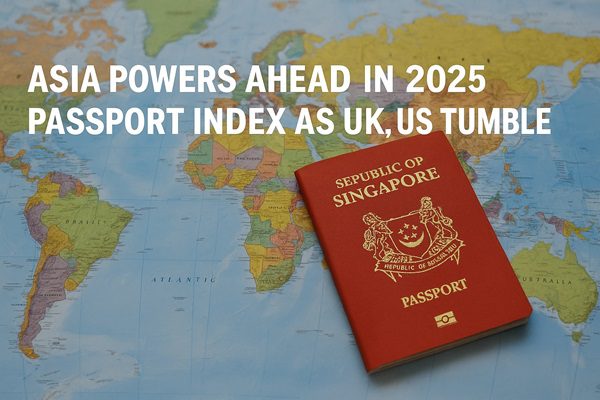
In the latest Henley Passport Index, proudly powered by IATA’s Timatic data, Singapore has snatched the crown for the world’s most powerful passport, offering unfettered access to a globe-trotting 193 destinations. However, the once-dominant passports of the United Kingdom and the United States continue their slow descent, trailing in 6th and 10th place, respectively.
While passport pages remain the same size, it’s clear that some carry far more weight than others.
The Rise of Asia: Stamps of Honour
Singapore’s dominance at the top of the 2025 rankings is no anomaly. Its regional neighbours are giving the Little Red Dot a respectable run for its (visa-free) money. Japan and South Korea jointly hold second place with 190 destinations each, underscoring Asia’s collective diplomatic muscle.
The real coup? Asia has dominated the podium and outpaced some of the world’s oldest empires — with nothing more than a handshake and a high-functioning foreign ministry.
The third rung is a continental affair — seven European nations, including Germany, France, Italy, and Spain, share equal footing with 189 destinations apiece. At the same time, the fourth tier is packed with familiar EU contenders. Yet, stoic and politely standing alone from Oceania, New Zealand is the only non-European passport to crack the fifth tier, rubbing diplomatic shoulders with Greece and Switzerland.
And at the very bottom? Afghanistan’s passport holders can travel visa-free to just 25 destinations. That’s a sobering 168-destination gap between top and bottom — proof, if any were needed, that where you’re born can still determine where you’re allowed to go.
UK and US: Once Mighty, Now Middling
Remember the good old days when a British or American passport practically guaranteed a warm welcome and a stamp with a smile? Those days are fading faster than a duty-free whisky on the red-eye.
The United Kingdom, once proud holder of the globe’s most powerful passport in 2015, now shuffles into sixth place. The United States fares worse, sliding into 10th, one step away from passport irrelevance in the world’s top tier.
The Yanks and Brits may still enjoy access to 186 and 182 destinations, respectively, but their diplomatic clout is waning. The real worry for Washington is that this is the first time the U.S. has flirted with the idea of dropping out of the top ten entirely since the index began two decades ago.
Strategic Diplomacy or Missed Flights?
“The consolidation we’re seeing at the top underscores that access is earned — and must be maintained — through active and strategic diplomacy,” says Dr. Christian H. Kaelin, creator of the Henley Passport Index and Chairman of Henley & Partners.
That’s a polite way of saying: don’t rest on your laurels, or you’ll find your passport no longer opens the doors it once did. Countries climbing the index are those that court bilateral visa-waiver agreements and keep up appearances at embassies and summits. Those who don’t? They slide.
Movers, Shakers and Jet-Set Makers
This year, India deserves an honourable mention, leaping eight spots up the index from 85th to 77th place. That leap, mind you, came with just two new visa-free destinations — proof that even small gains can change the game.
Never one to creep, Saudi Arabia added four new destinations to its tally, lifting the Kingdom to 54th place. And then there’s the UAE, which continues its meteoric rise: now in 8th place, up from 42nd just a decade ago — the most significant passport transformation in recent memory.
China, too, has entered the mobility conversation with gusto. Since 2015, Chinese passports have risen from 34th to 60th. And it’s not just where Chinese citizens can go — it’s who China is now letting in. Once famously restrictive, Beijing has recently granted visa-free access to over 75 nationalities. That includes South American players like Argentina, Brazil, and the Gulf Cooperation Council. In 2020, you’d have had better luck scoring an upgrade to first class.
Passport Power Is Economic Power
The Henley Openness Index, a cousin to the Passport Index, measures how welcoming a country is. And China’s new openness, while strategic, is helping fuel its soft power credentials. And let’s not forget the economic muscle behind these moves — access isn’t just about tourism anymore. It’s about trade, influence, and GDP-sharing.
By offering visa-free entry to select countries, China ensures its citizens — and those reciprocating — are part of a rapidly growing mobility club.
And it’s working. Henley’s research shows a stark economic trend: the stronger your passport, the greater your access to global GDP. In 2025, that equation has never been clearer.
Travel Demand Soars as Asia Leads the Way
Of course, all this mobility is good for business — particularly the business of flying. IATA boss Willie Walsh notes that global demand for air travel grew by 5.8% in the first five months of 2025. Asia-Pacific airlines led the charge with an impressive 9.5% spike.
North America, by contrast, saw international traffic rise a modest 1.8% — but domestic travel shrank by 1%, neutralising overall growth. “Despite economic and geopolitical uncertainties,” Walsh says, “consumer confidence remains strong, with robust forward bookings for the Northern summer.”
Translation? Asia’s growing passport power is fuelling jet engines — and the rest of the world is scrambling to keep up.
The Fall of the Once-Unshakeable
Only 16 passports have dropped in rank over the past decade, but among them are some high-profile embarrassments. Venezuela fell 15 spots, the U.S. dropped 8, and Vanuatu, the UK, and Canada have all slipped several places, leaving their citizens with fewer travel freedoms than before.
It’s a telling trend. Once-untouchable passports are being overtaken by those of emerging economies who are playing the long diplomatic game — investing in bilateral ties, visa reciprocity, and access.
Dr. Juerg Steffen, CEO of Henley & Partners, says, “Your passport is no longer just a travel document — it’s a reflection of your country’s diplomatic influence and international relationships.”
With growing geopolitical tension and rising inequality, it’s no wonder that more Americans and Britons are exploring second citizenships and alternative residencies — looking to hedge their bets with a Plan B (or in some cases, Plan Malta).
Conclusion: Power to the Proactive
The 2025 Henley Passport Index offers more than bragging rights for globe-trotters. It reflects the shifting sands of power, diplomacy and global mobility. In a world where borders open and close like automatic doors at an airport terminal, it pays to have a passport that gets you through — no questions asked.
And while traditional powers grow weary, the nimble and strategic are fast-tracking to the front of the queue.
So next time you’re fumbling at passport control, spare a thought for the genuine jet-setters. They didn’t just queue better — they negotiated better.
By Sandra Jones