
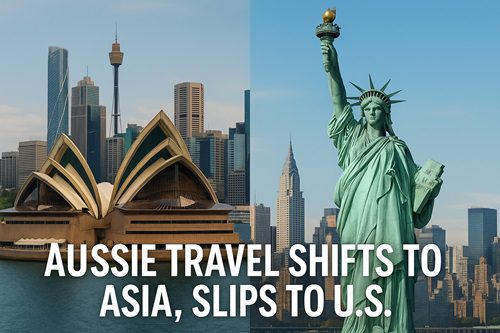
 There was a time — and not too long ago — when the glitz of Times Square or a selfie in front of the Golden Gate Bridge was considered the Holy Grail of the Aussie travel rite of passage. But if the latest numbers are anything to go by, it seems our fair dinkum adventurers have turned their sights elsewhere — eastward, in fact — and they’re doing it en masse.
According to the Australian Travel Industry Association’s (ATIA) Travel Trends Report for May 2025, Australians are ditching Disneyland in favour of dim sum. Outbound travel to the United States dipped a noticeable 6.2% in April compared to the same time last year, even while total international travel surged by a healthy 8.3%.
“It’s a subtle but significant shift,” said ATIA Chief Executive Dean Long, in a tone that suggested the Americans shouldn’t take it personally. “We’re seeing a noticeable softening in USA-bound travel by Australians, even as our appetite for overseas experiences remains as strong as ever.”
And where are we all headed instead?
Well, Asia is positively sizzling. Vietnam has turned up the heat with a staggering 28.5% rise in Aussie arrivals, while Japan and China have also chalked up impressive double-digit gains. For the full year ending April 2025, Japan was the standout star, with Australian visits up a whopping 33.8%. China followed with a 26.9% increase, and Vietnam with a 25% increase. There’s something irresistible about pho, cherry blossoms and panda encounters.
Long noted, “Holidaymakers continue to drive outbound travel demand, accounting for around 60% of all trips. The appeal of international experiences, especially across Asia, remains strong as Australians prioritise leisure travel.”
And it’s not just a short-lived fling. Aussies racked up 12.05 million outbound trips over the past year — a 12.1% jump year-on-year. Business travellers, however, appear to be staying put. Holiday and family visits are fuelling most of the numbers, while work-related jet-setting lags like a middle seat on a budget airline.
Even on the inbound front, the numbers paint a rosier picture. Australia welcomed 8.36 million international visitors in the year to April — up 6.7%. Much of that bounce-back came from familiar faces: China (+23.4%), Japan (+12.9%), and South Korea (+11.9%). New Zealand and the USA, meanwhile, decided to stay loyal — their numbers held steady, if not spectacular.
In April alone, the UK came roaring back into the top ranks with a whopping 39.5% jump in arrivals, while China again impressed with a 27.1% climb. But it wasn’t all smooth sailing — markets like Indonesia, Japan and Malaysia showed some mild retreat. Possibly too much nasi goreng back home?
From 30,000 feet up, the aviation picture remains competitive, with Qantas still cruising ahead as the top international carrier for Aussie travellers, holding a 15.8% market share and ferrying 528,000 passengers for the year ending February 2025.
But keep your seatbelts fastened — Jetstar has come barrelling down the runway with the most notable growth, lifting its share to 12% by flying 401,000 people (up from 11% the year before). Singapore Airlines also scored a modest bump to 9.4%, while Scoot and Tigerair hit a bit of turbulence, losing passengers and market share.
Total international airline passengers rose from 3.21 million to 3.35 million year-on-year — proof that, pandemic woes firmly in the rear-view mirror, Aussies are well and truly back in the skies.
And yet, even as we stretch our wings, there’s a note of caution — and a gentle reminder from ATIA that not all travel agencies are created equal.
Said Long with an air of fatherly advice: “These trends demonstrate the critical importance of a resilient and responsive travel sector to meet shifting consumer behaviours. We encourage Australians to always book through ATIA Accredited travel businesses to guarantee expert service, transparency, and peace of mind.”
In other words, if you’re about to click ‘confirm’ on a website you’ve never heard of offering a Maldives escape for $49, maybe take a deep breath and look for that accreditation logo first.
So, what does this all mean?
It means Australia is changing — not just in where we travel, but why we travel. The longing for connection, culture, cuisine — and yes, a cracking deal — is more potent than ever. Asia, with its close proximity and kaleidoscope of experiences, is perfectly poised to capitalise.
And as for America? Don’t count it out. The land of burgers, Broadway and baseball still holds plenty of allure. But for now, at least, the Aussie compass is pointing to the Orient — and business is booming.
By Sandra Jones