
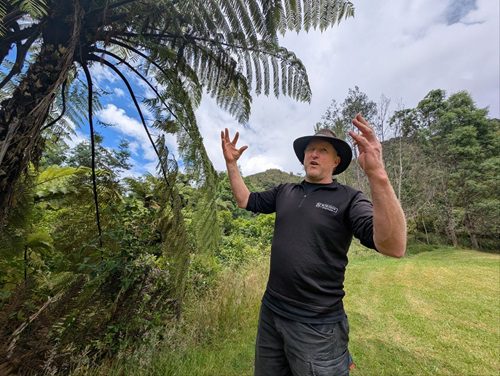
 On a hilltop overlooking New Zealand’s lush Whanganui River, Dan Steele is thinking about the future. Not just his future or the future of his sprawling ranch, Blue Duck Station. He’s thinking about all of New Zealand.
“You know,” he says, “New Zealand could be the biggest conservation project on Earth.”
Steele is a no-nonsense kind of guy, part conservationist, part Kiwi cowboy. His vision begins at Blue Duck Station, “out in the beginning of everywhere,” as he puts it. Here, he’s trying to combine responsible farming, tourism, and conservation in a way that may be unique to this island.
At the heart of Steele’s transformative idea is moving Blue Duck Station from traditional, unsustainable farming practices to planting trees for carbon offsets and eco-tourism.
“The world’s got to change,” he says. “We’ve got to think differently than we have to get to where we need to be.”
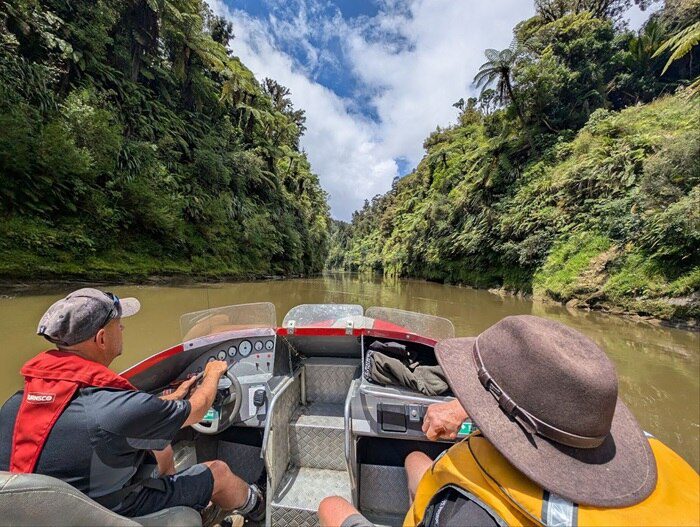
Motorboating on the Whanganui River in New Zealand. Photo by Christopher Elliott
How Blue Duck Station is changing ecotourism
Steele’s connection to Blue Duck Station dates back to 1993, when his parents purchased nearby Retaruke Station, a 2,100-acre property in New Zealand’s backcountry. The property included an abandoned homestead overlooking the river. Steele said that even though the home’s main residents were sheep and pigs, “it got right under my skin straight away.”
After returning from overseas travel in 1999, Steele bought a neighbouring property and founded Blue Duck Station, named for the elusive and endangered blue duck that nests along the Whanganui River. (In New Zealand, a large ranch is also called a station.)
Today, the property spans over 6,900 acres. The station runs 5,000 sheep and about 600 cattle. Blue Duck also offers a range of tourism experiences, including horse treks, guided hunting, and jet boating, along with lodging and fine dining at The Chef’s Table restaurant, which features produce grown on the farm.
Paul Carberry, founder of the tour operator New Zealand In Depth, describes Blue Duck as an outdoor enthusiast’s playground.
“It’s a fully immersive experience,” he says.
The farmstay concept is hardly unique to New Zealand, and there are countless ranches in this country that operate in a similar way. But Blue Duck is evolving.

Sheep grazing at Blue Duck Station in New Zealand. Photo by Christopher Elliott
A New Zealand ranch pivots to conservation
Steele has focused on conservation, working to plant trees, conserve water, and protect native animals from foreign predators. The goal is to create a self-sustaining environment for future generations.
Steele’s approach to conservation is multifaceted, encompassing various initiatives aimed at protecting and restoring the natural environment. His efforts include:
- Predator control: Blue Duck Station operates an extensive trapping program, utilising approximately 450 traps to reduce the population of rats and other predators that threaten native wildlife.
- Native species protection: The station is working to protect endangered species such as the blue duck, kiwi, and New Zealand falcon (kārearea), and aims to reintroduce species like the Brown Teal (pāteke) in the future.
- Land regeneration: Steele is reverting pastureland back to native bush, recognising that the land is unsuitable for intensive farming. He also plans to plant thousands of trees across the landscape.
These conservation efforts are closely tied to the station’s tourism and farming activities, demonstrating a holistic approach to sustainability. Steele says he believes that tourism can serve as a stepping stone to generating income that can be reinvested in conservation. But how?
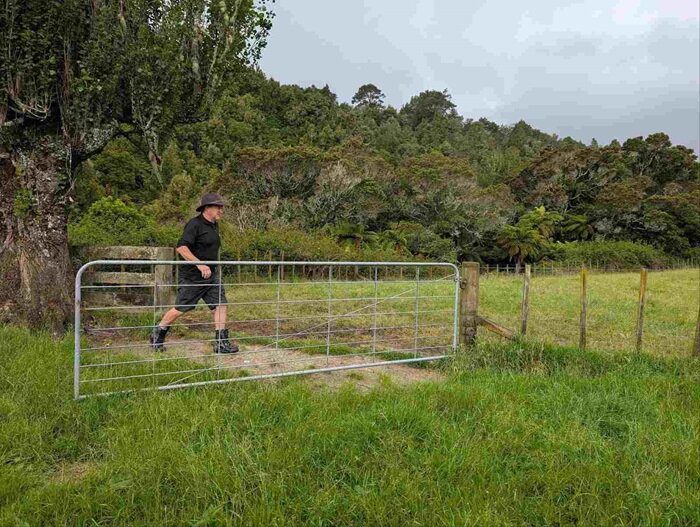
Steele checks on his cattle near the Retaruke River in New Zealand. Photo by Christopher Elliott
How carbon offsets and ecotourism can save New Zealand
Steele hops into an ATV, ostensibly to check on his cattle along the Retaruke River. And here’s where his story takes a twist.
All along the dirt road, Steele points to hillsides teeming with new poplar trees. The government has a program called One Billion Trees, which aims to plant one billion trees by 2028.
“The government pays us between $5 and $10 each to plant them,” he explains.
Within a few years, planting trees will overtake traditional farming as Blue Duck’s main source of income.
At the same time, Steele is cutting back on mass farming and moving toward smaller, more sustainable livestock operations. He is also working to eliminate the use of chemicals to control pests in livestock.
The plan is to return to natural farming methods that support biodiversity and animal health. Steele says he dislikes feedlots and over-intensification, believing that animals should live in harmony with nature, not as mere production units. He says his animals are raised in an environment that encourages natural behaviours. This approach is in direct contrast to the industrial farming practices that he sees as detrimental to both animals and the environment.
And finally, Steele aims to transition toward high-end tourism, highlighting the country’s natural beauty and its dedication to ecological stewardship. That means reducing the number of overnight accommodations and creating more five-star experiences, such as luxury cabins and glamping.
Is this the future of New Zealand?
Steele explains that by protecting its biodiversity, water quality and coastlines, New Zealand can create a healthy environment that attracts visitors. It’s an idea that might take root in a country heavily reliant on commercial farming, where tourism still has significant growth potential.
But it’s a move that requires a completely different business model — abandoning a commercial farming and mass-tourism model and doubling down on environmental stewardship.
As Steele looks out over his land, he sees a future where New Zealand is not just a beautiful place to visit but a beacon of sustainability for the entire world.
“I hope that my journey is an inspiration,” he says. “I think it all comes down to working with nature — not against it.”
By Christopher Elliott
BIO:
Christopher Elliott is an author, consumer advocate, and journalist. He founded Elliott Advocacy, a nonprofit organization that helps solve consumer problems. He publishes Elliott Confidential, a travel newsletter, and the Elliott Report, a news site about customer service. If you need help with a consumer problem, you can reach him here or email him at [email protected].