
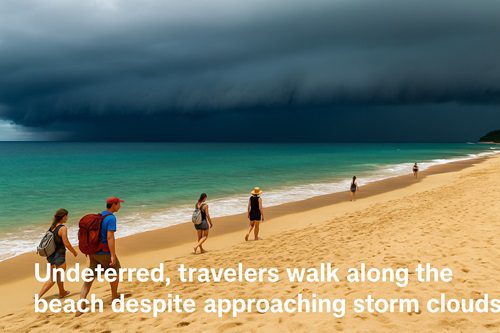
 As another storm season looms like an unwelcome in-law at a wedding, more than half of the world’s travellers are busy stuffing suitcases and booking beach villas as if the sky weren’t about to throw a tantrum. Forget flood warnings and hurricane forecasts—the modern tourist, it seems, has the memory of a goldfish and the optimism of a Labrador.
The Spring 2025 Global Rescue Traveller Sentiment and Safety Survey reveals what some of us have long suspected: common sense has packed its bags and left the terminal. According to the findings, 52% of travellers are “a little” concerned (that’s 20%) or not concerned at all (a breezy 32%) about the threat of natural disasters ruining their future travel plans. That’s despite forecasters predicting up to five major hurricanes this season alone—and nearly 40% of seasoned travellers admitting they’ve had holidays derailed by storms, smoke, or a surprise mudslide.
“It’s resilience,” insists Dan Richards, CEO of The Global Rescue Companies and a US Travel and Tourism Advisory Board member, perhaps trying very hard not to use the word “delusion.”
Richards sees this traveller defiance not as recklessness, but as a gutsy embrace of the globe’s new normal. “Even among those who don’t express concern, many are still experiencing the consequences firsthand,” he said, like a man gently warning his friend not to dry toast a marshmallow over a volcano.
From Canadian wildfires turning national parks into smokehouses to flash floods drowning carefully curated itineraries, the weather has become an impromptu tour guide—and not a very polite one.
Still, travellers persist. And not just continue—they flourish. Richards notes a 17% surge in security memberships in the past quarter. In other words, while travellers are shrugging off danger with one hand, they’re quietly signing up for emergency evacuations with the other. Classic case of “I’m fine… but just in case.”
In a world that now serves up more natural surprises than a Melbourne laneway menu, Richards believes the fundamental shift must be mental, not meteorological.
“Risk is now a permanent part of travel,” he says. “The solution isn’t to lock your passport in a fireproof safe. It’s to travel smarter. Know the lay of the land. Read the advisories. Pack more than sunscreen and blind optimism.”
And there’s the rub. The modern globetrotter—bless them—will check Instagram for the prettiest café in Santorini but won’t glance at a cyclone alert until their flight’s rerouted to somewhere they can’t pronounce. A cultural shift is overdue, says Richards.
“We need to move from ‘YOLO’ to ‘know before you go’,” he adds, no doubt resisting the urge to shake us all gently by the shoulders.
The industry is responding. Emergency alert apps are now a standard kit, concierge evacuation services are springing up like mushrooms after rain, and AI is being used for more than just choosing your hotel room. There’s genuine innovation happening. But even the cleverest tech can’t compete with sheer human stubbornness.
Richards puts it plainly: “Too many still think, ‘It won’t happen to me.’ That mindset is exactly what puts you in the headlines.”
So, if you’re planning a trip in 2025, take a moment to check the forecast—both meteorological and metaphorical. Make sure you’ve got emergency contacts, a plan B, and a little less bravado. Travelling smart isn’t boring—it’s brave with a brain.
Because while the tropics might promise turquoise waters and Instagrammable sunsets, they can just as quickly deliver an angry sky and airport chaos. And the only thing worse than a cancelled flight? A traveller who saw it coming… and did nothing.
By Jason Smith