
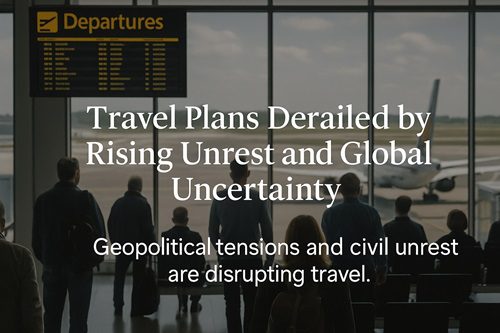
 Once upon a time, travel brochures promised the world — sun, sand, serenity. These days, they might need to include a foreign affairs briefing.
According to the Spring 2025 Traveller Sentiment and Safety Survey by Global Rescue, a leading provider of emergency response and travel risk management, it’s no longer exotic food or hotel star ratings that top the planning checklist. It’s whether the place is, quite frankly, on fire.
In what could be described as a sobering sign of the times, more than 85% of the globe’s most seasoned travellers now admit they’re at least “somewhat concerned” about geopolitical instability or civil unrest affecting their plans. A fair chunk — 13% — are deeply concerned, and nearly a third (28%) remain cautiously moderate. It’s a mood shift from wanderlust to wary.
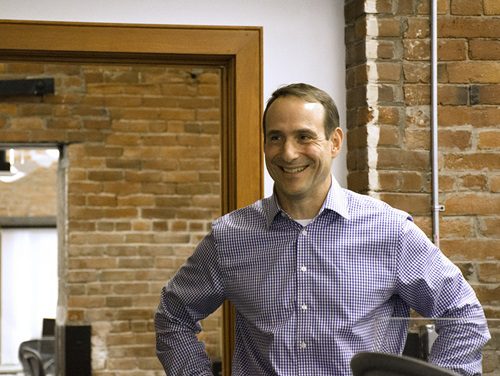
Dan Richards is standing in the operations room.
Dan Richards, CEO of The Global Rescue Companies and a member of the US Travel and Tourism Advisory Board, puts it bluntly:
“Safety concerns are no longer a secondary consideration—they are front and centre. Travellers are more aware, more informed, and more proactive than ever in assessing the political climate of a destination.”
And who could blame them? The travel game has changed, with protests flaring like matchsticks in unexpected corners of the globe and simmering tensions boiling over into full-blown conflict. Once a luxurious escape, travel is now a logistical equation punctuated by government warnings, political maps, and news alerts.
When Cancellations Come Before Confirmations
More than 30% of respondents confessed to cancelling or altering a trip because of unrest. It’s not just theory anymore—it’s personal. A staggering 88% of travellers actively research a destination’s political and social stability before considering booking flights or hotels.
It’s not just the seasoned globetrotters who check embassy websites and cross-reference risk indexes. This is now the norm, not the niche.
Even government advisories, once politely ignored in favour of blog posts or glossy travel influencers, are now shaping decisions. Over two-thirds of respondents said such warnings swayed them at least “a moderate amount.” A tiny but defiant 5% said they paid no attention — daredevils or the blissfully uninformed?
Travel Behaviour in the Age of Turbulence
The statistics are more than numbers — they reflect a global sentiment tilting away from spontaneity toward scrutiny.
Three-quarters of respondents said they would avoid destinations currently experiencing protests or unrest. Which, let’s be frank, wipes out an unsettling swathe of the globe. From the streets of major cities to remote corners once marketed as “untouched,” nowhere is immune to the ripple effects of modern geopolitics.
One particularly striking insight: when asked about the ongoing war in Ukraine and the safety of neighbouring countries such as Poland, Latvia, Czech Republic, and Estonia — all ranked at the US State Department’s safest Level 1 category — only 20% said they’d be more likely to visit if a ceasefire were declared. Meanwhile, 45% indicated they were not interested in visiting these countries in 2025.
The message? Safety ratings are one thing. Perception is another entirely.
“Even in regions classified as safe, perception matters,” Richards explained. “A conflict next door can be enough to alter travel demand across an entire region. It’s why clarity, transparency and timely advisory updates are essential—not just for traveller safety but for economic stability in global tourism markets.”
Economic Impacts Beyond the Boarding Gate
Indeed, behind every change in travel patterns lies an economic consequence. Airlines, hotels, tour operators, and street vendors are affected when a region becomes synonymous with risk. Fear isn’t just a psychological phenomenon — it’s an economic disruptor.
Destinations relying on international tourism can find themselves ghosted almost overnight, not because of their own instability, but because of their proximity to it. That’s the cruel irony of today’s global travel ecosystem: you don’t have to be the epicentre to feel the quake.
For travel advisors, insurers, and governments alike, the call is clear: Empower travellers with clear, updated, and transparent information. The old adage rings truer than ever—knowledge is power. And in 2025, it might be the passport stamp that matters most.
By Jason Smith