
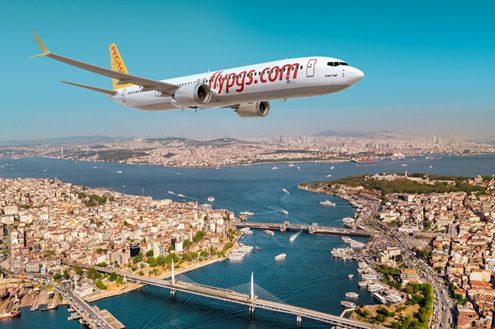
 In a bold leap worthy of the Wright brothers and Silicon Valley’s finest, Pegasus Airlines has officially teamed up with the University of California, Berkeley — and they’re not just tinkering with tray tables. They’re plotting a future where artificial intelligence, seamless air travel, and data-driven magic co-pilot the next generation of aviation.
This isn’t your garden-variety industry-university handshake over hors d’oeuvres. This is Pegasus, Turkey’s forward-thinking low-cost carrier, laying the groundwork for what may become one of the most transformative academic-industrial partnerships aviation has seen in years.
Soaring into Silicon Valley
Pegasus, which has quietly been muscling its way into the tech-savvy elite of the airline world, aims to break into the top three airlines globally for technology use. And they’ve packed a heavyweight in their carry-on: UC Berkeley, home to Nobel Laureates, disruptive startups, and a hive of high-voltage innovation.
Through the Pegasus Innovation Lab — cleverly nested in none other than Silicon Valley — the airline is positioning itself not merely as a mover of passengers, but as a mover of paradigms. In the global crucible of technology, Pegasus is launching its partnership with Berkeley’s Institute for Business Innovation, housed within the Haas School of Business.
And if that doesn’t turn heads in the boardrooms of rival carriers, perhaps their plans to rewrite the passenger experience through artificial intelligence and streamlined digital platforms will.
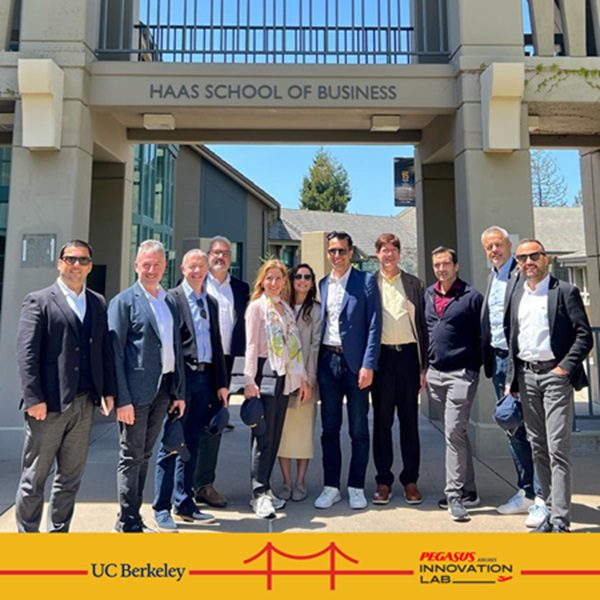
Pegasus and Berkeley minds unite to chart aviation’s high-tech future.
From Boarding Pass to Boarding School: Enter the Students
One of the more refreshing twists to this collaboration is its embrace of academic youth. Pegasus is actively working with Berkeley’s MBA students on a project dubbed “Seamless Air Travel.” The goal? Nothing short of a total digital transformation of how we fly — end-to-end self-service, personalised travel touchpoints, and a guest experience that doesn’t make you want to lob your boarding pass into the nearest bin.
This isn’t technology for its own sake. Pegasus is turning to bright-eyed future executives to help reimagine air travel in a genuinely user-focused way. As one insider quipped, “It’s not about putting more screens in the terminal — it’s about putting more intelligence behind the screen.”
Hackathons at 35,000 Feet
What do you get when you lock a bunch of brainiacs in a room with snacks and a looming deadline? The future of flight.
The Pegasus–Berkeley Innovation Hackathon has emerged as another crown jewel of this venture. These intense, idea-packed sprints are designed to tackle challenges like AI-powered customer service, predictive operations, and more innovative scheduling — all things that make a travel experience less turbulent and more tailored.
The best of these innovations may soon be flying off the drawing board and into airports across the globe, as Pegasus looks for scalable solutions that can give it a real edge in a fiercely competitive industry.
Building a Culture of Innovation, Not Just Code
Significantly, Pegasus is also investing inward. The airline is rolling out in-house training for staff in artificial intelligence and data analytics. But this isn’t just a crash course in jargon; it’s part of a longer-term mission to foster a culture where creativity and data-savvy thinking are as everyday as the safety demonstration.
It’s an effort that harks back to the airline’s roots: an appetite for pushing boundaries, matched with a respect for structure and service. This time, however, it’s being underwritten by algorithms and academic rigour.
Beyond the Runway: A Long-Term Vision
What sets this partnership apart is its depth and ambition. This isn’t about a flashy pilot project with a few press releases and photo ops. It’s a long-haul journey.
Pegasus and UC Berkeley are banking on a future where airlines don’t just move people—they lead in innovation, sustainability, and brilliant, human-centred service. They believe this is only achievable by combining the strengths of industry and academia.
As Pegasus sees it, tomorrow’s airline will be just as much about knowledge transfer as it is about passengers and payload. It’s not about who has the biggest fleet anymore. It’s about who has the sharpest minds — and who’s not afraid to let them fly.
By Octavia Koo