
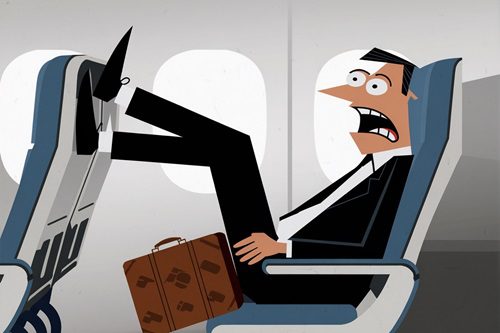
 Are airlines tightening their carry-on luggage rules? Passengers like Eddie Cannon believe the answer is “yes.”
Cannon was flying from St. Louis to Atlanta on Delta Air Lines when a flight attendant ordered him to store his carry-on bag under the seat in front of him.
“I didn’t have room for my feet,” he says.
Instead, he tried to place his bag in the overhead bin. He says the attendant stopped him and told him that he would be removed from the flight if he didn’t comply.
Cannon is no loose cannon. He’s a vice president of an AI company and knows how to behave on a plane.
Cannon complained to Delta and the Department of Transportation, which regulates airlines. In response, Delta said its request to put carry-ons where your legs normally go is to maintain an on-time departure and to leave room in the overhead bins for other luggage.
“Thank you for your thoughts on this matter, which will be shared with our in-fight services leadership team in order to improve our service where it’s needed,” it added. He also received 15,000 bonus miles as an apology.
But Cannon wonders about the stricter carry-on rules. “Are they trying to make more money on checked baggage?”
Why are airlines cracking down on carry-on luggage?
It’s no secret that airlines make billions of dollars a year on checked luggage. They’re also always looking for ways to increase their revenues.
Sometimes, government regulators can become their unwitting accomplices. Last fall, European regulators considered limiting the maximum dimensions for carry-on luggage to 21.6 inches x 15.7 inches x 7.8 inches and 17.6 pounds. The move is meant to improve the boarding process, but it will probably also improve the airline industry’s profits.
Reports suggest that U.S. carriers see the new rule as an opportunity to further restrict carry-on luggage and potentially increase income from checked luggage fees.
Delta said it has not changed its carry-on rules but may be enforced differently depending on the circumstances.
A representative told me that “due to weight and balance on certain flights, crew members may ask customers to place smaller, personal items under their seat. ”
If you want a preview of things, try booking an airline ticket on a discount airline in Australia or Asia. Gate agents there are already super-strict about size and weight limits, as I discovered on a recent visit. They weigh and size everything.
If you go over even a smidge, you’ll have to repack — or pay extra.
“I’m so upset about this,” says Jack Ezon, who runs the luxury travel agency Embark Beyond. He stopped checking his bags a decade ago because he doesn’t trust airlines with his belongings.
In his view, the way to improve luggage revenue is to stop losing passengers’ luggage — not by forcing them to downsize their carry-ons.
But it’s not the only way.
Don’t overpack
I know this is obvious, but the best way to avoid any trouble with your carry-on bag is to comply with the published rules. Don’t take any chances. Make sure your carry-on fits the smallest standards, which in your case will probably be the new European ones. Your bag should easily fit in every template and pass every weight test.
Obey the rules and you won’t need any of these other tips. But you might still need help because the new carry-on restrictions are slightly restrictive. People have more stuff. How do you get it past the authorities?
Pack smarter — much smarter.
It’s not enough to pack less and lighter, says travel agent Maria LaDuca. You have to start thinking about the optics. If you’re a couple, you probably each carry your own bag on a plane. It makes sense to keep things separate. But in an era of stricter carry-ons, you have to think differently. “If you’re traveling with someone, spread out the heavier stuff,” advises LaDuca. (I do this too when I’m travelling with my adult son. If my bag is a little heavier and his is a little lighter, we strategically repack at the airport to avoid the luggage police.)
Make them look the other way.
A kind word at the ticket counter can distract a ticket agent from spotting your XL carry-on. I’ve seen it, and I’ve also used it, and it works. “The first thing I do is to greet the counter staff and ask how they are doing,” says Y. Murat Ozguc, a frequent traveller who runs a tour operator in Turkey. “I’ve never had a problem with a few additional kilos.”
Be discreet
That’s the recommendation of Justin Crabbe, who says backpacks are perfect for squeezing past stricter carry-on rules. He says the latest backpacks can do more with less — they’re made of ultralight materials and modular, adaptable designs. But mostly, a black backpack worn during check-in is practically invisible to a ticket agent, even one slightly too big or heavy. It just blends in. “Pack in a way that maximises space and minimises waste,” adds Crabbe, a frequent flier who is also the CEO of a private jet company. “Use compression cubes. Limit toiletries to travel sizes.”
There’s a silver lining.
The changes are not all bad. While airlines will undoubtedly make more money off the extra luggage their passengers will check, they will also improve the flying experience.
“These measures are pivotal for optimizing boarding speed, managing the limited overhead bin space, and ensuring safety by preventing cabin overcrowding,” notes Frank Harrison, regional security director for the Americas at World Travel Protection.
Caitlin Higgins, a frequent traveller who works for an interior design site in Los Angeles, recently experienced the benefits of a flight from Sydney to Wellington, New Zealand.
“It was my fastest international boarding experience,” she recalls. “I’m happy that folks are no longer holding up boarding as they struggle to lift and shove their oversized carry-ons into too-small bins.”
Of course, there was also a downside. The luggage cops flagged her “tiny” carry-on and forced her to check it.
She’d better get used to it. We all had better get used to it.
By Christopher Elliott
BIO:
Christopher Elliott is an author, consumer advocate, and journalist. He founded Elliott Advocacy, a nonprofit organisation that helps solve consumer problems. He publishes Elliott Confidential, a travel newsletter, and the Elliott Report, a news site about customer service. If you need help with a consumer problem, you can reach him here or email him at [email protected].