
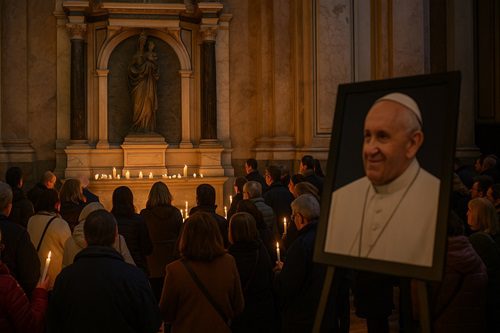
 You could feel it in the cobblestones. Rome held its breath. Buenos Aires blinked back a tear. And across the globe, Catholics and even the spiritually undecided reached for their rosary beads—or a boarding pass.
Pope Francis, the people’s pope, the Jesuit who rode the bus and preached mercy before might, has passed. But he’s set off one final movement—not of words, but of feet. Pilgrims, seekers, tourists with souls, and strangers to religion alike are on the move, tracing the earthly steps of a man who gave the papacy its most human face in a generation.
From the leafy laneways of Flores—his humble Argentine stomping ground—to the soaring spires of the Vatican, the trail has become a tapestry of grief, reverence and quiet awe.
“It began the moment his health took a turn,” said Enrique Espinel, the sharp-eyed COO of Civitatis, the Spanish-speaking world’s answer to Viator. “Our Free Tour del Papa in Buenos Aires—once a once-a-month curiosity—has now become a daily ritual. This week alone, bookings have jumped more than 100%.”
They’re not here for Instagram. They’re here for insight. For communion. For the chance to walk through the neighbourhoods, parishes and pulpit shadows that formed Jorge Mario Bergoglio’s moral compass. In Rome, the queues at the Vatican stretch just a little longer, though, in truth, it feels more like a procession than a line.
This is tourism, yes—but not as we know it. It’s spiritual travel and booming for all the right reasons.
There’s something about losing a man like Francis that makes people want to feel closer to something, or someone, greater. In a world spinning fast with cynicism, his papacy was a pastoral hand on the shoulder—a reminder that leadership could be tender, and that the Church, with all its ornate regalia, could still have a beating, humble heart.
Now, in death, he’s brought us one last sermon—delivered not from a balcony, but through the streets of his story.
Argentina’s tourism ministry is already planning a “Camino del Papa,” a mapped pilgrimage route through his hometown, where basilicas and barbershops tell stories of the boy who became a bishop. Never short on saints, Rome is seeing a quiet but significant swell in visitors booking papal legacy tours—more heartfelt, less hurried.
Spirituality, it turns out, is good for business—but only when done with care.
And the travel industry is rising to the occasion with an uncommon grace. Gone are the fast-talking guides waving umbrellas. In their place are theologians-turned-tour-operators, passionate locals, and priests who compassionately deliver context. There’s reverence in the itineraries—empathy in the air.
But perhaps the most stirring thing of all? The diversity of those turning up.
Some are Catholic, some are lapsed, some are spiritual but not religious, and others are just curious to understand how a pope from South America, with a cheeky grin and a fierce belief in kindness, came to move millions.
And move them, he did.
He moved refugees to safety, hardened hearts to compassion, institutions toward inclusion, and now, even in death, he moves people in the most literal and figurative senses.
“Travel doesn’t always need a beach,” said one Australian traveller I met outside San José de Flores. “Sometimes it just needs a reason.”
Indeed. And what better reason than to remember a man who asked us not to judge, but to walk beside one another?
So, if you’re headed to Rome or riding the Subte in Buenos Aires anytime soon, you might notice more people staring quietly into the middle distance. That’s not jet lag. That’s a reflection—a spiritual pause in a secular rush.
Because Francis—God bless him—wasn’t just the Pope. He was the pilgrim who showed us how to walk humbly with our God, and how to travel light—with purpose, grace, and just enough mischief to remind us we’re all only human.
By Sandra Jones