

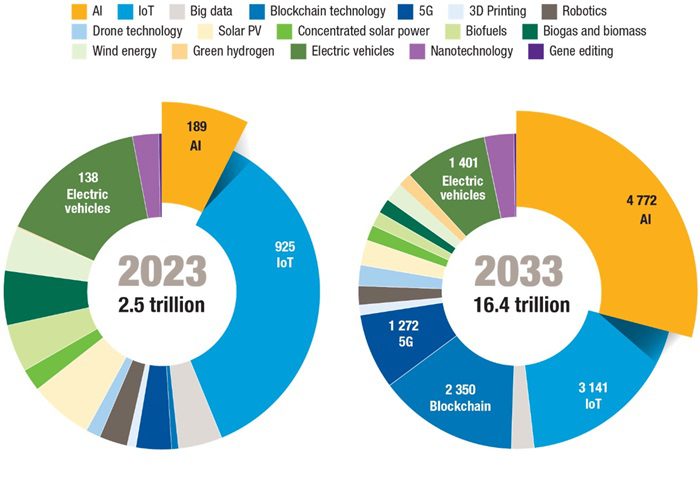
 As artificial intelligence (AI) accelerates toward becoming a $4.8 trillion global powerhouse—rivaling Germany’s GDP—the United Nations is sounding a powerful alarm: Act now or risk widening a deep and dangerous divide.
In a bold new release of its Technology and Innovation Report 2025, the United Nations Conference on Trade and Development (UNCTAD) has made it abundantly clear that while AI promises prosperity, innovation, and transformation, it also carries the looming specter of deepening global inequality.
“We must put people—not just profits—at the center of AI development,” urged UNCTAD Secretary-General Rebeca Grynspan. “Only through inclusive governance and international cooperation can we shift from a tech-centric world to one rooted in shared human progress.”
🧠 A Trillion-Dollar Technology with Trillion-Dollar Consequences
UNCTAD’s projections reveal a staggering growth trajectory for AI, expected to reach a market value of $4.8 trillion by 2033. That’s nearly equivalent to the entire GDP of Germany, one of the world’s largest economies.
However, a select few harvest the fruits of this digital revolution. An elite group of just 100 companies in the United States and China currently command 40% of global corporate R&D spending in AI.
Leading tech juggernauts such as Apple, NVIDIA, and Microsoft have amassed individual valuations of around $3 trillion each—surpassing the entire GDP of the African continent.
Such monopolization raises critical concerns: Without shared access to digital infrastructure and innovation, developing countries risk being left behind in the technological abyss.
Less than one-third of developing countries have AI strategies
⚙️ AI Is Disrupting Workforces: 40% of Global Jobs at Risk
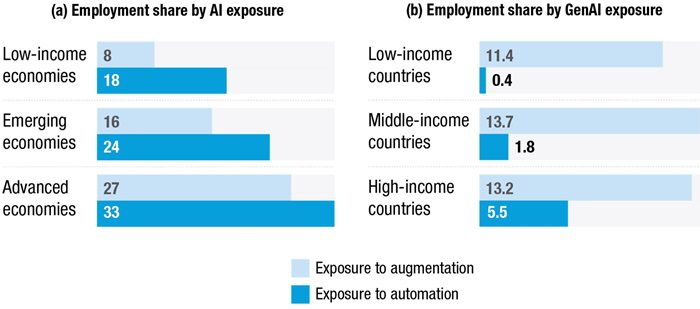
UNCTAD’s report cautions that up to 40% of jobs worldwide could be disrupted by AI-driven automation. And while this technological leap could spark productivity booms, it also threatens to upend labor markets, particularly in nations dependent on low-cost labor.
“Automation powered by AI tends to favor capital over labor,” the report states. “This could erode the competitive edge of many developing economies if we do not invest in upskilling and education.”
The stakes are clear: without decisive policy responses, millions could be displaced, widening income gaps and destabilizing already fragile economies.
However, there’s a silver lining. AI isn’t only about automation—it’s about augmentation. If governments strategically invest in reskilling and digital education, workers can survive the shift and thrive in it.
🏗️ Infrastructure, Data, and Skills: The New Development Trifecta
UNCTAD highlights three essential levers that every country must master to harness AI for national prosperity:
-
Infrastructure – Accessible cloud computing, robust internet access, and AI-specific hardware
-
Data – Transparent, secure, and ethically managed datasets that support innovation
-
Skills – A digitally literate workforce ready to lead and adapt
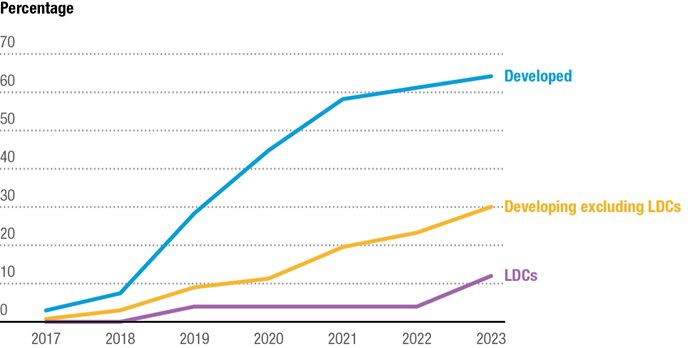
Yet, most nations are not prepared. Fewer than one-third of developing countries have adopted any national AI strategy.
“Strategic investment in people, systems, and knowledge is no longer optional—it is the cost of entry into the future,” said one UNCTAD analyst.
Up to 40% of global jobs impacted, requiring proactive labour policies
🌍 The Governance Gap: 118 Nations Left Behind
Perhaps most alarming is this statistic: 118 countries—predominantly from the Global South—currently have no voice in international AI governance frameworks.
This exclusion has wide-ranging implications. As global standards are being forged, many countries are missing the chance to shape AI ethics, transparency, and use policies.
UNCTAD warns that unless governance becomes more globally inclusive, AI will become another force controlled by the few and suffered by the many.
🛠️ A Roadmap to Inclusive AI: What Must Be Done
UNCTAD offers a set of policy recommendations that can steer the world toward inclusive, people-centered AI development:
-
An AI-equivalent of ESG: A global public disclosure framework that ensures transparency and accountability for AI use, similar to how companies report on environmental, social, and governance (ESG) standards.
-
Global Shared AI Infrastructure: A multilateral cloud and hardware network that enables developing countries to access cutting-edge AI capabilities.
-
Open Innovation Ecosystems: Championing open-source models and open data to democratize AI resources and prevent monopolistic dominance.
-
South-South Cooperation: Direct resource and knowledge sharing among developing nations, designed to scale AI education, governance, and innovation frameworks.
Less than one third of developing countries have AI strategies
⏳ Time Is Ticking—But the Future Is Ours to Shape
This is not a technology problem—it’s a policy problem. The future of AI must not be dictated solely by profit-driven giants or tech-first ideologies. Instead, AI must become a global public good, championed by all and governed for the benefit of all.
“The decisions we make today about artificial intelligence will determine the course of global development for generations,” Grynspan concluded. “We must not hesitate. We must lead—with purpose, with people, and with a shared vision for the future.”
🔚 Final Thought
Artificial Intelligence is not destiny—it’s a decision. The world stands at a crossroads. With coordinated action, visionary leadership, and inclusive governance, AI can uplift humanity rather than divide it. But the time to act is now.
Written by Sandra Jones