
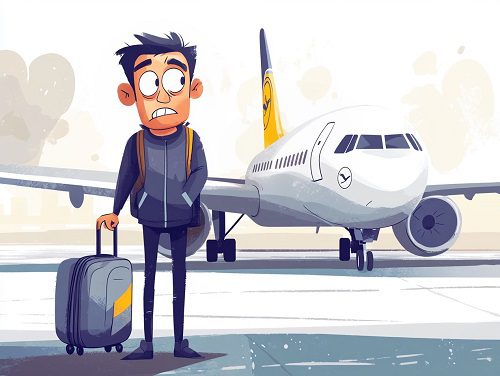
 Lufthansa made a booking error that cost Scott Davis more than a flight to Rome.
It also tested his patience with a hidden fee, a mind-boggling bureaucracy, and world-class corporate stubbornness.
Oh, and it unfolded over a long time. If you can believe it, this one goes back to the pandemic.
So, you can probably imagine how Davis felt when his case landed on my desk.
“I will never fly on Lufthansa again,” he said.
How did we get here?
Davis’ case highlights the challenges passengers face when dealing with airline errors and the often convoluted process of obtaining refunds. It also underscores the importance of persistence and documentation, knowing what to do when even having something in writing doesn’t work.
It also raises a few questions:
- How long should an airline refund take?
- Can airlines add hidden fees to a ticket?
- What if an airline tries to refund a closed credit card?
Before we get to that, let’s figure out what happened to Davis.
“The day before I had a confirmed reservation to fly to Rome, Lufthansa canceled my flight.”
Davis had booked a ticket from Washington, D.C., to Rome through Priceline just before the pandemic, but Lufthansa cancelled his flight after the COVID-19 outbreak. The airline offered him a ticket credit, which he accepted.
He rescheduled his flight after the pandemic — or so he thought.
“The day before I had a confirmed reservation to fly to Rome, Lufthansa canceled my flight,” he recalls.
Why? Lufthansa says because he had an Economy Lite ticket, he owed the airline $199.
“Lufthansa said I would not get credit for the original reservation unless I paid the fee,” he adds. “I was stunned to learn this and cancelled the reservation.
Whoa, wait a second.
First, shouldn’t Lufthansa have refunded him for a cancelled flight during the pandemic? Yes, but it appears it offered him a credit, which he accepted. That’s allowed.
Didn’t Lufthansa inform him of the rebooking fee when the credit was issued? There’s no evidence that it did so.
So, how did he make a reservation without paying the fee? That’s a good question, which our advocacy team asked Lufthansa. I’ll get to the response in a moment.
Now, on with the story.
Davis asked for a full refund of the $1,067 spent on the tickets. Although Lufthansa could have said “no”—after all, he had accepted a ticket credit—it agreed to refund the money.
And that’s when the problems started.
Lufthansa: We’re working on it!
Lufthansa’s initial responses were generic and unhelpful, citing high travel volume and promising to contact him soon.
Two months later, the airline acknowledged that it was working on his refund request. A few days later, Davis discovered it had refunded him only $127 without any explanation.
After several weeks of silence, Davis contacted Lufthansa’s head of customer relations. In response, Lufthansa admitted that the full refund had not been processed and promised to investigate.
A month passed with no updates. Davis followed up again, requesting information about the status of his refund. Lufthansa claimed their investigation was complete and that a full refund would be processed.
But weeks turned into months, and the refund remained elusive.
Almost six months after starting his refund request, Davis grew increasingly frustrated and contacted Lufthansa’s CEO, urging him to expedite the refund process. He also expressed concern about the lack of communication and the inconvenience caused by the delayed refund.
Finally, Lufthansa issued his refund — to an inactive credit card.
It took weeks for Lufthansa to realise its mistake and promise to send the money to his bank account instead. When would the money come? Lufthansa wouldn’t say.
It had been over nine months since Lufthansa’s error forced him to cancel his trip, and the airline was still dragging its feet on the refund. And that’s when Davis came to us.
How long should an airline refund take?
The saga of Davis’ missing refund suggests airlines like Lufthansa have no deadline to issue refunds. But they do.
When an airline cancels or significantly delays a flight, passengers who choose not to travel are entitled to a prompt refund. The U.S. Department of Transportation (DOT) defines “prompt” as within seven business days for credit card purchases and within 20 days for purchases made with cash or other forms of payment.
This applies to both refundable and nonrefundable tickets.
What’s more, new rules enacted last year require the refund to be automatic. (The rule went into effect after Davis’ case.) Airlines must automatically issue refunds without passengers having to request them or navigate complex procedures. The rule also specified that airlines are not allowed to force passengers to accept travel credits or vouchers, although passengers may still choose to receive them. Refunds must be provided in cash or the original payment method used for the purchase.
Another new requirement is that the refund must cover the full ticket price, including government taxes and fees and airline-imposed fees.
In other words, Davis should have gotten his money back promptly, but there’s a grey area regarding the timing requirement because he’d purchased the ticket through Priceline. Nonetheless, Lufthansa was testing the limits of the DOT rules.
But it’s not the only rule being tested.
Can airlines add hidden fees to a ticket?
Airlines should always tell passengers about rebooking fees at the time of booking. The DOT has strict rules about that, too.
Airlines must disclose the full price of a ticket, including taxes, fees, and surcharges in advertising on their websites and e-ticket confirmations. They must also disclose fees for optional services like baggage and seat selection through a prominent link on their website and include this information in e-ticket confirmations.
In his case, Lufthansa disclosed the $199 change fee on its site but did not send him any other notification. It’s unclear how he was able to make a reservation without first paying the fee or why Lufthansa contacted him shortly before his departure to demand payment of the fee.
Davis’s experience with Lufthansa suggests that airlines sometimes fail to adequately inform passengers about specific fees, leading to confusion.
But on this issue, there is no confusion: Hidden fees are illegal. Lufthansa definitely made a booking error when it allowed his initial reservation to go through without the required $199.
(Parenthetically, a $199 rebooking charge is one of the more questionable fees in the airline industry. I can understand why Davis balked at paying. After all, he didn’t cancel the initial flight.)
What if an airline tries to refund a closed credit card?
Perhaps the final insult in this refund odyssey was that Lufthansa tried to refund the money to Davis’ closed credit card. Of course, he never received it.
Payment systems are pretty sophisticated, so most banks redirect a refund to a new or replacement card. If that doesn’t work, the money goes directly to the customer’s bank account (if you have one). But if you have a new card from a new bank, all bets are off. That’s the situation in which Davis found himself.
Lufthansa doesn’t have a formal mechanism for rerouting a refund on its site, so everything had to be done manually, which can take time.
How to handle a refund to a closed credit card
Airlines have a reputation for being rigid when it comes to processing refunds. If you’re not careful, you might find yourself without your money — or with an extended wait. Here’s what you need to know.
- Get in touch with the airline. If the refund doesn’t show up within 14 days, contact the airline’s customer service team. They may ask for additional details, like the new card information or your bank account information, to manually process the refund. Be prepared to provide proof of the transaction and the refund request.
- Contact the credit card company. If you’ve long since closed your credit card and no longer have access to the account, contact the credit card issuer. It can usually trace the refund and redirect the payment to your new account.
- Consider an appeal. If you can’t get the refund, you may need to escalate the issue through your bank or consider filing a complaint with the Consumer Financial Protection Bureau or through a reputable consumer advocate.
A closed credit card doesn’t mean your refund is gone forever. But it can create complications, including long waits. Your airline is unlikely to offer much help beyond refunding the original card. If you are waiting for a refund and things seem stuck in limbo, contact your credit card issuer for assistance. And be patient.
Can we get his money back?
I can only think of one advocate who can handle a multilayered airline problem like this: Dwayne Coward. After helping Davis with advice and contact information, it became clear the promised refund was stalled. So, it was time to give Lufthansa a nudge.
A few days later, we received some good news:
“I’m glad to be able to tell you that after Lufthansa’s actions forced me to cancel an eagerly anticipated trip to Italy, they finally sent me the refund they had been promising,” he said. “Thank you for Elliott Advocacy’s help.”
Lufthansa never told Dwayne why Davis could make a reservation without paying the required booking fee. We expected that, and you probably did, too.
Davis wanted one more thing.
“I’m shocked both by how long it took and the dysfunction at a major international corporation this experience revealed,” he added. “The refund, while welcome, does not reimburse me for the cost of reservations I had to cancel in Italy, the interest on the money that could have been earned over nine months, the absurd amount of effort it took to get the refund, and the great disappointment of missing out on a trip I had put much effort into organizing.”
Davis would like other travellers to know about this awful experience as they consider using Lufthansa. I told him I would be happy to write about it.
Interestingly, since Davis’ case, Lufthansa has gone into complete radio silence. The airline does not respond to our queries, believing that if it ignores us, the problems we bring to them will disappear. Then again, maybe our messages are getting lost in the bureaucracy.
Written by: Christopher Elliott
BIO:
Christopher Elliott is an author, consumer advocate, and journalist. He founded Elliott Advocacy, a nonprofit organization that helps solve consumer problems. He publishes Elliott Confidential, a travel newsletter, and the Elliott Report, a news site about customer service. His latest book is The Unauthorized Travel Manual. If you need help with a consumer problem, you can reach him through his nonprofit site or email him at [email protected].