
 From personalized pricing to emerging booking channels, AI is set to reshape revenue management, guest experience, and overall business strategy. Here are my five cents for navigating these changes and positioning your hotel, resort, or casino for success in an AI-driven world.
Embracing generative AI
Generative AI should be our primary focus this year. Similar to the early days of the internet, we’re at a pivotal moment where the dominant platforms of the future are still taking shape. What’s clear, however, is that generative AI will be a core driver of the technologies shaping tomorrow’s hospitality landscape.
The rise of personalized pricing
Personalized pricing is one of the most exciting trends I see on the horizon. As AI-driven bots and agents evolve, they will enable travellers to query hotel databases, unlocking tailored pricing directly and offers at an unprecedented scale. While still in its early stages, I anticipate we’ll see the first consumer-facing applications emerge by the second half of 2025.
The new era of booking channels
Regulatory pressures on industry giants like Google and Booking.com and the growing ubiquity of generative AI search are paving the way for entirely new booking channels.
These channels will revolutionize how guests interact with your business, altering booking behaviours, lead times, and trends. As consumers gain more flexibility and agency in their travel planning, we must shape our strategies to meet evolving expectations.
Empowering small and independent properties

Jordan Hollander, Co-founder, Hotel Tech Report.
Historically, large chains had access to powerful revenue management tools and data-driven strategies that smaller players could only dream of. However, the rise of AI has levelled the playing field.
As an independent hotel, you now have the opportunity to implement advanced revenue management strategies, such as personalized pricing, predictive analytics, and demand forecasting, without the need for vast resources. This is groundbreaking, not just for increasing efficiency but also for staying competitive in such a saturated market.
AI-enabled KPIs
With AI at the forefront, we must evolve towards data-driven analysis and decision-making. I believe return on ad spend (RoAS) and labour expense will be two of the most critical metrics taking centre stage:
RoAS: As new customer acquisition channels emerge, monitoring RoAS at the channel level will be essential. AI will help us track and optimize the efficiency of these channels, ensuring marketing investments deliver strong returns.
Labour expense: With staffing costs continuing to rise, we must focus on controlling these expenses. AI presents a significant opportunity to reduce costs by automating routine tasks and improving operational efficiency without sacrificing quality.
A dual strategy for AI adoption
The rapid advancements in AI present both opportunities and challenges. While AI holds massive potential, it also disrupts the status quo, forcing us to rethink operations and growth strategies.
To succeed, I believe we must adopt a dual strategy:
Invest in adaptive technologies: Focus on short-term solutions that keep the business competitive.
Allocate resources for innovation: Prepare for long-term opportunities by experimenting with emerging technologies and processes.
Balancing short-term growth with the agility to adapt to industry shifts, like new channels or evolving consumer expectations, will be critical.
Rising tech spending and accelerated digitalization
As AI proves its value, I fully expect tech spending in our industry to rise this year.
Increasing labour costs will drive the adoption of AI-driven automation to replace manual processes and improve efficiency. From streamlining data entry to delivering personalized guest experiences, AI will enable superior outcomes while reducing costs.
To encourage further digitalization, we must prioritize the development of user-friendly technology. One of the main obstacles to adoption has been the complexity of hotel tech systems. By creating intuitive, accessible tools similar to the apps we use daily, we can make the value of these technologies clear and compelling.
Staying ahead
We must lean into AI-driven strategies to drive efficiency, enhance personalization, and fuel growth to stay ahead. Partnering with AI-focused tech providers and scrutinizing our business processes to identify areas where AI can unlock value is essential for beating the competition.
Success this year requires agility, foresight, and a willingness to embrace change. Whether it’s reducing operational time, uncovering more profound insights, or improving results, those who prioritize AI will position themselves as leaders within the industry.
2025 Hospitality Trends Report
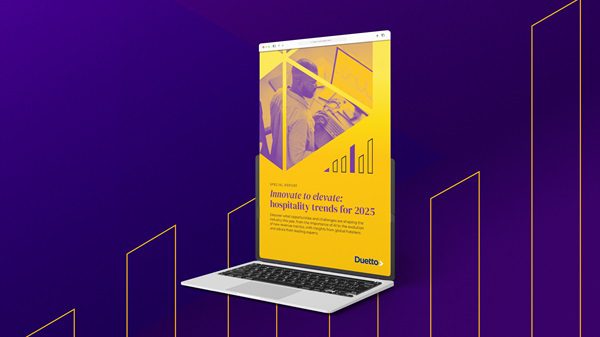
These insights are drawn from Duetto’s 2025 hospitality trends report, which analyzes factors that impact the industry this year. The report features perspectives from global revenue management professionals and leading industry voices, including executives from Hotel Tech Report, Sandos Hotels & Resorts, CP Hospitality, Noble House Hotels & Resorts, the Sandman Hotels et Sutton Place Hotel Group, and Grand Metropolitan Hotels.
From embracing AI to redefining revenue metrics, it provides a roadmap for turning today’s challenges into tomorrow’s successes. With real-world applications and forward-thinking strategies, including insights from leading hotels, casinos, and resorts, this report delivers actionable tools to help revenue professionals stay ahead of the competition and thrive in 2025.
Written by: Jordan Hollander, Co-founder, Hotel Tech Report
BIO:
Jordan Hollander is the co-founder of Hotel Tech Report. He was previously on the Global Partnerships team at Starwood Hotels & Resorts. Before his work with SPG, Jordan was Director of Business Development at MWT Hospitality and an equity analyst at Wells Capital Management. Jordan received his MBA from Northwestern’s Kellogg School of Management, where he was a Zell Entrepreneurship Scholar and Pritzker Group Venture Fellow.