
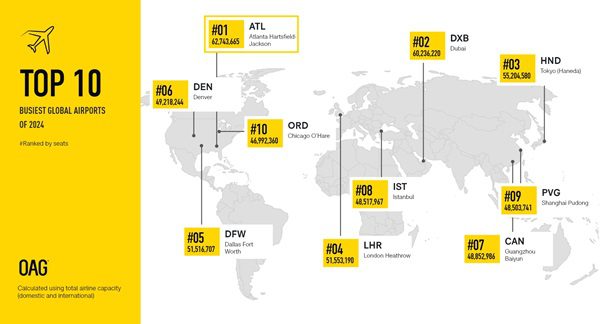
 In a landmark revelation by OAG, the premier global travel analytics data platform, Asia-Pacific airports emerged as the pivotal players reshaping global aviation in 2024. The rankings underscore the region’s remarkable recovery and growth, with Tokyo Haneda (HND), Shanghai Pudong (PVG), and Guangzhou Baiyun (CAN) achieving unprecedented milestones.
Tokyo Haneda Soars to New Heights
Tokyo Haneda Airport (HND) maintains its prestigious rank as the world’s third busiest airport. Achieving a stellar 4.8% year-on-year capacity growth, Haneda handled an impressive 55.2 million seats in 2024. Its consistent performance underscores Japan’s strategic importance in international and domestic connectivity.
Shanghai Pudong: The Fastest Growing in the Top 10
Shanghai Pudong International Airport (PVG) stole the spotlight as the fastest-growing airport globally. Rising from 15th to 9th position within a year, PVG achieved a staggering 29% capacity growth year-on-year. This phenomenal leap highlights China’s robust recovery and the increasing demand for travel in the Asia-Pacific region.
Guangzhou Baiyun’s Global Debut
Guangzhou Baiyun Airport (CAN) debuted among the global Top 10 busiest airports. This remarkable achievement reflects the airport’s strategic development and increased international connectivity. Baiyun’s entry into this elite list in 2019 signifies the region’s strengthening aviation infrastructure.
Asia-Pacific’s Powerhouses in International Travel
Seoul Incheon (ICN) leads the Asia-Pacific region regarding international seat capacity, climbing from seventh in 2023 to third in 2024 with 41.6 million seats. Singapore Changi (SIN) and Hong Kong (HKG) are closely followed, with 41.5 million seats and 34.6 million seats, respectively. HKG reported an astounding 40% year-on-year growth, further cementing its role as a key global hub.
Global Context: The Busiest Airports in the World
While Atlanta Hartsfield-Jackson International Airport (ATL) retains its crown as the World’s Busiest Airport with 62.7 million seats, Dubai International Airport (DXB) holds second. London Heathrow (LHR) ranks fourth, showcasing the enduring strength of Western aviation hubs amidst the Asia-Pacific surge.
Expert Insights on Asia-Pacific’s Aviation Dominance
Mayur Patel, OAG’s Head of Asia-Pacific, emphasized the region’s significant progress:
“Our latest rankings confirm the strength of the Asian market recovery through 2024, with Shanghai Pudong the fastest growing amongst the top ten entrants and Guangzhou Baiyun International entering the list for the first time. The strength of hubs like Seoul Incheon, Singapore Changi, and Hong Kong highlights the region’s critical role in global connectivity and catering to evolving traveler demands.”
Asia-Pacific’s Key Role in Aviation’s Future
The OAG rankings highlight Asia-Pacific’s impressive recovery and its growing dominance in shaping global aviation trends. Airports such as Haneda, Pudong, and Baiyun drive the region’s emergence as a powerhouse in international connectivity, responding dynamically to evolving traveller needs and demands.
For the full rankings and in-depth methodology, visit OAG’s official website.
This explosive growth reflects not just recovery but innovation and strategic foresight across the Asia-Pacific region, offering a window into the future of global travel and connectivity.
Written by: Soo James