
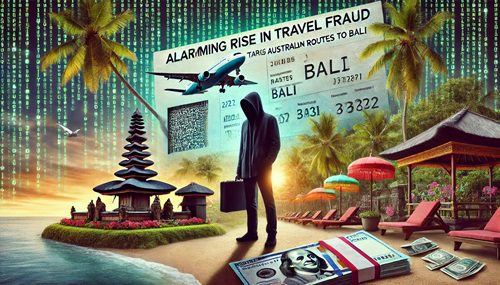
 Australian travellers are facing an alarming surge in fraudulent activities, particularly on flights bound for Bali, according to a newly released report by Riskified, a global leader in eCommerce fraud and risk intelligence. The report exposes a shocking reality: flights departing from Australia to Indonesia are 2.5 times more likely to involve fraudulent tickets or transactions than other routes.
Indonesia is a top travel destination for Australians, and this surge in fraud underscores the increasing sophistication of international crime syndicates targeting unsuspecting travellers and travel providers.
Fraudulent Hotspots: The Riskiest Routes Revealed
Riskified’s study analyzed Australia’s top 10 international travel destinations, identifying Bali-bound flights as the most at-risk for fraud. Flights to the United States and the United Arab Emirates were ranked second and third, with risks two times and fifteen percent above average, respectively. Over the past year, the likelihood of fraud in flight purchases climbed by 14%, reflecting a growing trend in cybercrime within the travel sector.
“This issue remains largely under the radar for most travelers,” said Riskified’s ANZ Country Manager Nicholas Kirtley. “Fraud in the travel sector spans a wide range—from stolen credit cards being used to purchase tickets, to fake ticket sales on the dark web. These scams often leave travelers stranded and unaware they’ve fallen victim until they reach the airport.”
The Mechanics of Fraud: How Gangs Operate
Organized crime rings, hailing from countries like Indonesia, China, Russia, and parts of Europe, have honed their operations to exploit vulnerabilities in the travel sector. These sophisticated groups leverage stolen credit card information to buy tickets, later reselling them on platforms offering “too-good-to-be-true” deals.
Fraudsters also employ “buy-for-order” schemes, wherein tickets are purchased with stolen details on demand. This leaves victims with invalid tickets and exposes their financial information to further theft.
Kirtley explained, “Unlike other sectors where mismatches between credit card locations and IP addresses raise red flags, the inherently global nature of travel complicates fraud detection. This gives criminals the perfect cover to operate undetected.”
Loyalty Points: A Growing Target
The report also sheds light on another growing area of concern—fraud involving airline loyalty programs. Known as Account Takeover (ATO), criminals infiltrate frequent flyer accounts to steal reward points, redeeming them for flights, upgrades, or even gift cards, often reselling them for profit.
Fraudsters employ phishing techniques, creating fake airline websites or emails that trick users into divulging login credentials. Some exploit system loopholes to generate phantom transactions that accrue loyalty points without legitimate activity.
“We’ve seen scammers collaborate on the dark web to share strategies for transferring stolen loyalty points between accounts,” Kirtley revealed. “This underground market is thriving, with fraudsters even offering their services to execute these schemes on behalf of others.”
The Bigger Picture: Travel as a High-Risk Category
Compared to other eCommerce sectors, travel—encompassing flights and hotel bookings—poses one of the highest risks for online fraud. While consumer perception often associates eCommerce scams with electronics or apparel, the travel sector’s vulnerabilities remain underestimated.
“Many don’t realize how lucrative travel fraud has become,” Kirtley stated. “Unlike physical goods, where shipping details can be tracked, the intangible nature of flights and hotel bookings allows criminals to exploit gaps in verification processes.”
Fraud in this category also extends to gift card scams, where perpetrators use stolen points or credit card data to purchase travel-related vouchers, further monetizing their schemes.
Protecting the Industry and Consumers
As fraud tactics evolve, the travel industry must adopt advanced detection systems to safeguard travellers and providers. Businesses are urged to collaborate with fraud intelligence platforms like Riskified to stay ahead of emerging threats.
For consumers, vigilance is vital. Travelers are advised to:
- Avoid purchasing tickets from unofficial or unverified sources.
- Regularly monitor loyalty program accounts for suspicious activity.
- Use secure payment methods and avoid public Wi-Fi when booking travel.
- Be wary of phishing emails or websites that mimic legitimate airlines.
Conclusion: A Call to Action
The findings of Riskified’s report are a wake-up call for the Australian travel sector. Proactive measures are essential to mitigate the risks as criminals grow bolder and more organised. For travellers, knowledge and caution are the best defences against becoming victims of fraud.
As the travel industry grapples with these challenges, platforms like Riskified ensure global travel security. By addressing these vulnerabilities, the sector can achieve a safer, fraud-free future.
For more information on safeguarding against travel fraud, visit Riskified’s website.
Written by: My Thanh Pham