
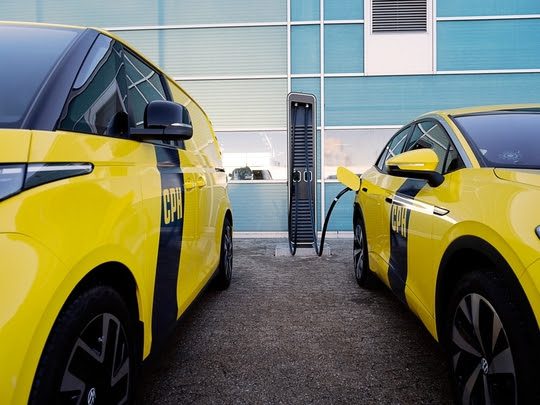
 The potential in intelligent control of traditional and Vehicle-to-Grid (V2G) charging stations in parking facilities is significant. Electricity costs can be reduced, and the management can help decrease CO2 emissions. This is demonstrated in a new report prepared by Hybrid Greentech, Danish Technological Institute, and Copenhagen Airport in the EU project ALIGHT.
There are great opportunities for sustainable gains and healthy business if there is a focus on intelligent management of Vehicle-to-Grid (V2G) and fast-and destination charging stations in parking facilities. This is shown through analysis and testing at Copenhagen Airport, the largest airport in Scandinavia with approximately 15,000 parking spaces, with an increasing number equipped with charging facilities.
A new report describes how intelligent charging management in parking facilities can reduce CO2 emissions and electricity costs. The report, prepared in the EU project ALIGHT, which Copenhagen Airport, Danish Technological Institute, and Hybrid Greentech are part of, also provides various recommendations for implementation and ownership structure for the charging stations.
“With the report, we hope to bring the many advantages of intelligent charging control into focus. Electric vehicles and batteries provide a lot of flexibility for a large electricity consumer, which is worth utilizing. Therefore, we also focus on what an airport or other owners of parking facilities and charging infrastructure need to know to understand the commercial potential and how to take advantage of the flexibility,” says Andreas Barnekov Thingvad, Trading Systems Director at Hybrid Greentech.
Electric vehicles as part of a battery system
Around the clock, there are an average of 5,000 cars parked in the parking areas at Copenhagen Airport, and a growing number of them are electric vehicles. At the same time, as part of its climate program towards 2030, Copenhagen Airport will electrify its fleet of large vehicles such as trucks, buses and other special equipment.
As it is costly to electrify large vehicles, which are only used for few hours per year, it makes sense to connect the large vehicles to V2G charging stations so they can charge and discharge like a stationary battery. With the large number of vehicles planned to be electrified, Copenhagen Airport can quickly obtain Denmark’s largest battery capacity.
“This will in many ways make sense. When the vehicle functions as a mobile battery, it will reduce the payback period of the investment. Additionally, if there is intelligent management of the V2G solution, it will result in lower electricity costs and reduced CO2 emissions,” says Thomas Steen Jensen, Energy Engineer at Copenhagen Airport.
Report with recommendations
Copenhagen Airport, Danish Technological Institute, and Hybrid Greentech have developed algorithms for managing batteries and various types of charging stations. The management is being tested at Danish Technological Institute and subsequently planned demonstrated at a series of the airport charging stations in conjunction with a forthcoming stationary 900 kW/1200 kWh battery.
“Danish Technological Institute’s Energy Flex Lab allows for testing different control strategies and energy systems, contributing to ensuring an efficient integration of stationary batteries, charging stations, and electric vehicles into the existing energy system, as well as validating the CO2-and business gains from smart management,” says Lea Kornbeck Askholm, Engineer in electrical energy technology at Danish Technological Institute.
The analysis results are presented in the report “Potential of Smart Charging and V2G.” Here, you will find recommendations for technical implementation, ownership structure for the charging stations, and market interaction with electricity suppliers, balance responsible parties, and the transmission system operator.
The report also looks at the value of intelligent charging based on spot prices and CO2 emissions in the electricity grid, and how much can be earned by making charging stations available to transmission system operator as a flexible resource that can be reduced in the event of major imbalances in the electricity grid.