

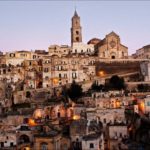
 Far from Italy’s usual tourism hotspots, wedged in the instep of Italy’s boot between the heel and toe, Basilicata is known for its traditional agricultural practices and rugged picturesque landscapes including the dramatic UNESCO World Heritage hilltop town of Matera.
The region is also home to beaches, bays and small rocky coves along its Tyrrhenian and Ionian coasts, as well as Italy’s largest national park, Pollino, with its genuinely untouched scenery and wild outdoor experiences. For a destination in Italy with all the hallmarks of a la dolce vita escape, here’s why Basilicata should be on your must-visit list.
Hilltop hamlets
Basilicata is best known for the UNESCO-listed city, Matera, but many more hilltop villages can be discovered on a trip across the region, where rural climes are paired with rich history and spectacular scenery.
Matera is one of the most famous hilltop towns in Basilicata, renowned for its unique cave dwellings known as “Sassi” which have been inhabited for thousands of years. Castelmezzano, nestled in a valley between two mountains, is also a popular destination for outdoor enthusiasts. The “Volo dell’Angelo” (Flight of the Angel), allows visitors to zip-line between Castelmezzano and nearby Pietrapertosa while enjoying breathtaking views.
Tursi is another hilltop town with a rich history, known for its medieval architecture, narrow streets, and views of the surrounding countryside. One of the highlights is the Cathedral of San Nicola, which dates back to the 12th century.
Unique outdoor experiences and stunning landscapes
Home to Pollino National Park, the lakes of Monticchio, the landscapes of Val d’Agri and the seaside beauty of the Tyrrhenian coast.
The region’s lakes and coasts are some of Italy’s most magnificent but they remain relatively quiet even in the height of summer. In Potenza province, the small town of Maratea is known as the pearl of the Tyrrhenian Sea. Its crystal-clear sea views act as a mosaic for the entire landscape. The charming village is made up of narrow streets lively with local restaurants and craft shops.
Pollino, the largest national park in Italy, extends across the border of Calabria and within this thinly inhabited area you can explore vast expanses barely touched by humans. The park’s rugged, grassy mountaintops ascend to 2,248 metres at Monte Pollino, and during the cooler seasons when the skies are clear, the views extend to the distant island of Sicily.
A haven for cycle holidays
As one of Italy’s smaller regions, Basilicata’s villages, wilderness, beautiful beaches, and rugged mountains are perfect for discovering by pedal power.
With its two coastlines, tranquillity, and laid-back Italian way of life, Basilicata is the perfect place to explore on two wheels. Depending on the time of year, you might have the opportunity to witness local festivals, events, or markets which can provide an authentic glimpse into the daily lives and traditions of the people of Basilicata. What’s more, most cycling itineraries pass through railway stations and most tracks cross low-traffic roads.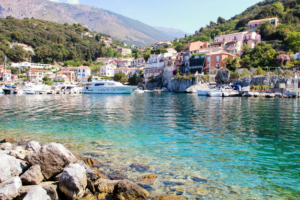
In 2021, the region received an Italian Green Road Award thanks to the cycle route connecting Matera and the Lucanian Dolomites. The 114-kilometre route meanders through nature reserves and small hilltop villages. Cyclists can see sites such as the Vulture Melfese, Murgia Materana, Gallipoli Cognato, Potenza, the Val D’Agri Park and Maratea.
Sip and swirl your way through a hidden gem wine destination
While it might not be as famous as Tuscany or Piedmont, Basilicata has been making strides in recent years to establish itself as an important wine-producing area.
Basilicata is one of the smallest wine-growing regions in Italy, and its vineyards can be found almost exclusively around the extinct volcano, Vulture, in the northeast of the region. These vineyards are among the highest in Europe, with some lying over 1000 meters above sea level.
Basilicata’s wine industry is centred around its indigenous grape varieties and unique terroir. One of the most notable, Aglianico, produces robust and complex reds that are rich, full-bodied and age well. The region’s mountainous terrain and volcanic soils contribute to the distinct character of its wines.