
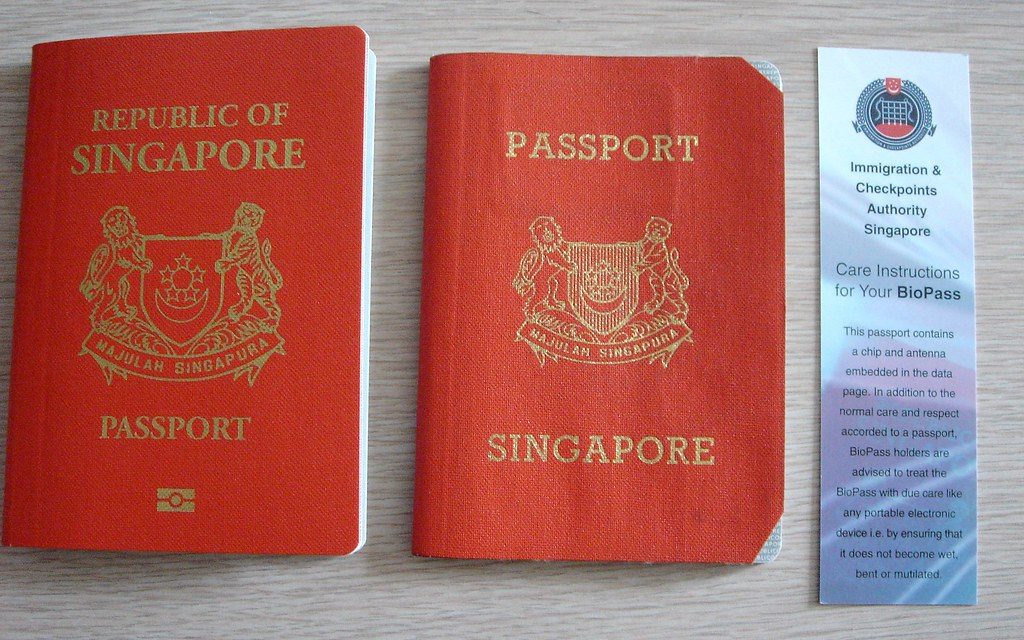
 Singapore has clinched the title of the world’s most powerful passport, dethroning Japan from its five-year reign, as revealed by the latest Henley Passport Index. The rankings, generated using authoritative data from the International Air Transport Association (IATA), place Singapore in the lead, offering visa-free entry to 192 of 227 global destinations. European nations Germany, Italy, and Spain trailed closely, seizing second place with access to 190 destinations. At the same time, Japan, Austria, Finland, France, Luxembourg, South Korea, and Sweden occupied the third spot with entry to 189 countries.
After enduring a six-year descent in rankings, the UK experienced a comeback, advancing to fourth place. Conversely, the US witnessed a persistent decline over a decade, slumping two additional spots to the eighth position, boasting access to only 184 countries visa-free. It’s worth noting that a decade ago, both nations shared first place, underscoring the stark contrast in their trajectories over the years. The Index also highlighted the ongoing plight of Afghanistan, Iraq, and Syria, which continued to hold the dubious distinction of having the weakest passports globally.
The 18-year trajectory of the Henley Passport Index indicates an increasing trend towards enhanced travel freedom. The average number of destinations travellers can access visa-free nearly doubled from 58 in 2006 to 109 in 2023. However, the gap in global mobility between top and bottom index entrants has never been more pronounced. The highest-ranked Singapore enjoys visa-free access to 165 more destinations than Afghanistan, lodged at the bottom of the index.
Henley & Partners Chairman, Dr Christian H. Kaelin, commented that only eight nations worldwide had seen a decrease in visa-free access compared to a decade ago. In contrast, others have made commendable strides towards securing more extensive travel freedom. He cited the UAE’s monumental leap from 56th to 12th rank over the past decade, adding a staggering 107 destinations to its visa-free scorecard since 2013. This surpasses the second-largest climber, Colombia, which climbed 28 places. Kaelin stressed that a strong passport not only delineates our travel liberties but also offers considerable economic liberties, facilitating international investment and business opportunities.
Reflecting on the continuous diminution of America’s passport power, Greg Lindsay, a leading global strategist at Cornell Tech’s Jacobs Institute, highlighted the lackadaisical growth of the US in terms of its Henley Passport Index score. Compared to Singapore’s boost of 25 points in the past decade, the US has only added 12 new visa-free destinations to its tally. Lindsay, featured in the Henley Global Mobility Report 2023 Q3, also underlined the growing discrepancy between the travel freedoms enjoyed by American citizens and the openness extended to other nationalities by the US.
This shift has been a concern for Annie Pforzheimer, a former career diplomat with the U.S. Department of State, who perceives this stagnation as a potential threat to the U.S.’s influence if it continues to impose barriers on international business activities and fosters a perception of hostility towards outsiders.
In an endeavour to comprehend the association between a country’s openness to foreign nationals and its citizens’ travel freedom, Henley & Partners pioneered the Henley Openness Index. This index categorizes countries according to the number of nationalities they permit entry to without a visa. It highlighted that the most open countries are typically small island nations or African states, except Cambodia. In stark contrast, Afghanistan, North Korea, Papua New Guinea, and Turkmenistan scored zero, providing no visa-free access to any nationality.
This complex interplay between travel freedom and openness to foreigners is contingent on each nation’s socioeconomic realities and diplomatic agendas. Singapore and South Korea, countries that have experienced substantial upward mobility in the Henley Passport Index in the past decade, also exhibit high degrees of openness. In contrast, the US and Canada have slid down the top 10 rankings due to stagnating openness.
While the US allows visa-free access to 184 countries for its citizens, it only extends the same courtesy to 44 other nationalities, reflecting a startling discrepancy. It’s not alone, however; Australia, Canada, New Zealand, and Japan have also shown similar trends, either dropping the rankings or maintaining their positions over the last decade.
Highlighting the socio-economic implications of visa policy, Dr Juerg Steffen, CEO of Henley & Partners, posits that fostering openness and strengthening passport power can provide lucrative investment opportunities for international investors and entrepreneurs. A robust passport facilitates economic mobility, aids in mitigating regional or country-specific risks, and unlocks access to innovative and wealthy markets.
In this era of increasing global connectivity, passport power and openness to foreign nationals have become crucial determinants of a nation’s standing on the global stage. As countries strive to balance their diplomatic and socio-economic goals, the world will keenly watch the following seismic shifts in the global mobility landscape.
Written by: Kevin Hall