
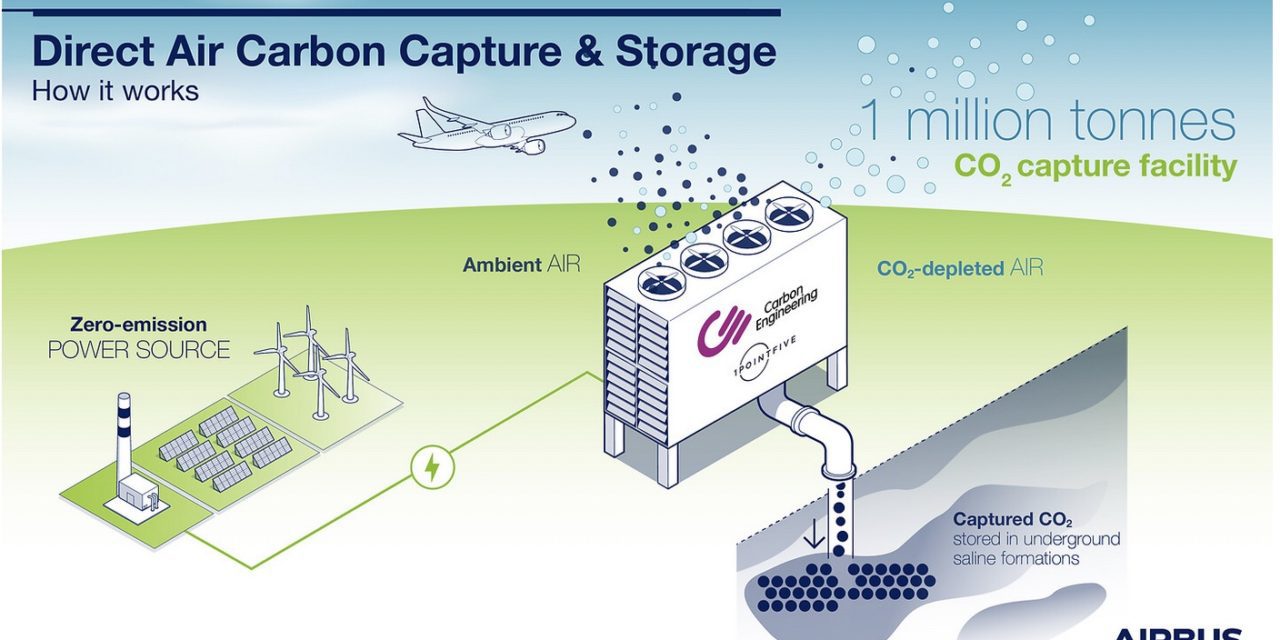
 Airbus, the plane maker, has embarked on a program of removing carbon directly from the air, a process that may eventually let the aviation sector take as much carbon from the air as it produces.
Direct Air Carbon Capture and Storage (DACCS) is a way of extracting human-produced carbon dioxide (CO2) from the air, thus helping various industries meet their net-zero carbon emissions targets.
Airline emissions can’t be captured directly from source, as they are emitted in flight, often at high altitude – so DACCS is viewed as a promising complementary means of abatement, alongside sustainable aviation fuel and hydrogen.
To put money behind its vision, Airbus has invested in Carbon Engineering Ltd, a Canadian-based company that operates a massive Direct Air Carbon Capture (DACC) research and development facility, claimed to be the world’s largest.
The Airbus investment will help fund part of Carbon Engineering’s advanced direct air capture research and development technologies at the company’s Innovation Centre in Squamish, British Columbia, Canada.
“Carbon Engineering’s Direct Air Capture technology provides a scalable, affordable solution to decarbonise aviation,” Carbon Engineering’s chief executive, Daniel Friedmann, stated.
“We are thankful to Airbus for taking action and continuing to lead the way by helping accelerate solutions for the industry and for the climate.”
Commenting on the Airbus investment (the size of which was not disclosed), Airbus vice president ZEROe Ecosystem, Karine Guenan, said the move reaffirmed Airbus’s “commitment to the use of direct air carbon capture as a two-fold solution for the decarbonisation of the aviation industry”.
DACC involves capturing CO2 emissions directly from the air using high-powered fans. Once removed from the air, the CO2 can be used to produce power-to-liquid Sustainable Aviation Fuel (SAF) “that is drop-in compatible with today’s aircraft”, Airbus says.
Captured atmospheric CO2 can be stored in geologic reservoirs.
“Deep saline formations” are seen as having the biggest capacity for permanent and safe CO2 storage, according to Airbus.
These are saltwater reservoirs – rocks with porous spaces that are filled with brine. They exist widely on Earth.
Airbus sees the process as letting the aviation industry “extract the equivalent amount of emissions from its operations directly from the air, thereby counterbalancing residual emissions”.
Whether it would work on a planetary scale remains to be seen. Global energy-related CO2 emissions rose by 6% in 2021 to 36.3 billion tonnes, their highest-ever level, as the world economy rebounded strongly from the Covid-19 crisis and relied heavily on coal to power that growth, according the most recent International Energy Agency analysis.
Of those emissions, only a fraction is airline-related – but the total gives an idea of the scope of the challenge. Who can visualise the sort of volume that 36.3 billion tonnes of CO2, a gas, would occupy? For that matter, who can visualise 36.3 billion tonnes of anything?
Airbus views its investment in Carbon Engineering as a key part of its global climate strategy, which encourages the development and deployment of direct air capture technology, “among several technological pathways in support of the aviation industry’s decarbonisation ambitions”.
The transaction also suits the Airbus strategy of growing its contribution to the Canadian economy.
“Airbus supports the recently-launched Clean Technology Key Industrial Capability in Canada, under the Industrial and Technological Benefits Policy,” a company statement said.
Written by Peter Needham