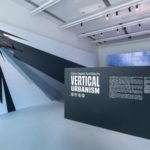
 Hong Kong Design Institute (HKDI) and Hong Kong Institute of Vocational Education (IVE) (Lee Wai Lee), together with its affiliated HKDI Gallery, are honoured to present its flagship exhibition of the year “Zaha Hadid Architects: Vertical Urbanism”.
Held at HKDI Gallery and virtually from now until 3 April 2022, the exhibition aims to showcase Zaha Hadid Architects’ (ZHA) innovations in architecture through a display of projects with a variety of project documentation tools – from technical drawings and diagrams, computer-generated visualisations, and architectural models, to video projections and virtual reality experiences. The immersive online exhibition of “Zaha Hadid Architects: Vertical Urbanism” builds on the Gallery’s popular digital offering of contemporary design exhibitions, allowing the wider global audience to journey through ZHA’s formative projects, zoom into visual details of architectural models, and experience multimedia elements at their leisure.
The late architect Zaha Hadid (1950 – 2016) injected a new level of dynamism into architecture. Her vision has been explosive, fluid and boundless, forcefully questioning the need for urban fortifications in her drive to establish a continuous, active ground-plane. The investigative spirit on which Hadid based her career continues in ZHA’s ground-breaking work around the world.
Curated especially for the Institutes, the exhibition will present a range of approaches taken by ZHA in their development of vibrant and sustainable community-orientated spaces within dense urban conditions. It also explores ZHA’s ongoing research and development, detailing the investigative spirit and pioneering innovation inscribed within the studio’s architecture that are recognised around the world. The exhibition is thematically structured around three aspects of ZHA’s work: exploring the studio’s designs for towers in cities around the world; showcasing ZHA’s seminal projects in the region and expounding on the research of ZHA’s Computation & Design research group (ZHA CODE).
The exhibition begins with a significant work of Zaha Hadid, on display near the entrance, The Peak project in Hong Kong. Though never built, the project was considered Hadid’s breakthrough project, metaphorically flipping Hong Kong’s iconic skyscrapers to generate a horizontal cluster of beams, with a large public void carved out between the geological intervention. The Peak project won Hadid global attention and offered an early glimpse into the concepts and methodologies within ZHA’s work, as showcased in the exhibition – from the experimentation on structures that push the traditional boundaries, to floating fluid forms, as well as the integration of public spaces within dense urban environments.
The next section features the research of ZHA’s Computation & Design research group (ZHA CODE). ZHA CODE collaborates with the world’s leading scientific institutions to develop innovations in robotics, artificial intelligence and digital fabrication which, in turn, inform ZHA’s design process. Building a comprehensive understanding of local supply chains, materials, craftsmanship and manufacturing, ZHA CODE develops design and logistical strategies with new construction technologies that ensure each project is fundamentally sustainable by using as little material and energy as possible in its assembly and operations. Highlighted exhibits include Thallus, a robotically printed experimental sculpture.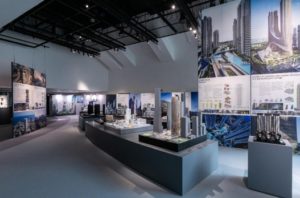
ZHA is delivering vertical urban architecture with experiential and communicative value. Incorporating a selection of the studio’s renowned tower projects from around the world, the last portion of the exhibition examines the studio’s innovations in moving beyond the existing paradigm of tower design and enhance urbanism in the 21st century. The exhibition also presents two award-winning projects closer to home that encapsulate ZHA’s vision: the Morpheus Hotel at City of Dreams Macau, as well as the highly anticipated The Henderson tower to be completed in Central, Hong Kong. Both are designed as contemporary structures with an exterior that differentiates the buildings along its vertical axis, as well as a complex void unfolding inside, yet with vistas and bridges also opening out into the urban context. Other highlighted projects include One Thousand Museum tower in Miami, and the Leeza SOHO tower in Beijing.
The online exhibition of “Zaha Hadid Architects: Vertical Urbanism” is available to view at: https://www.hkdi.edu.hk/en/hkdi_gallery/gallery.php?product_id=217.
As part of the comprehensive exhibition programme, a master lecture led by Patrik Schumacher and industry panel discussions will also be offered online in February and March respectively, in which architecture masters will dive deep into the theme of vertical urbanism and examine the agenda of tower typology that will re-structure urban societies in the 21st century.
Vertical Urbanism
The exhibition incorporates a selection of ZHA’s tower projects from around the world. ZHA is delivering vertical urban architecture with experiential and communicative value. Incorporating a selection of the studio’s renowned tower projects from around the world, this portion of the exhibition examines the studio’s innovations in moving
beyond the existing paradigm of tower design and enhance urbanism in the 21st century.
In his formative essay for the exhibition, Patrik Schumacher outlines five critical components of 21st century tower design that are explored within the exhibition: Density; Atria + Bridges; Façade; Ground Interface; and Sustainability. “The skyscraper seems locked in the bygone Fordist paradigm of segregating segmentation and serial repetition. The tower typology is the last bastion of this bygone era. The time is ripe to challenge the standard tower typology and demand that it too participates in the general societal restructuring from Fordism to Post-Fordism.”
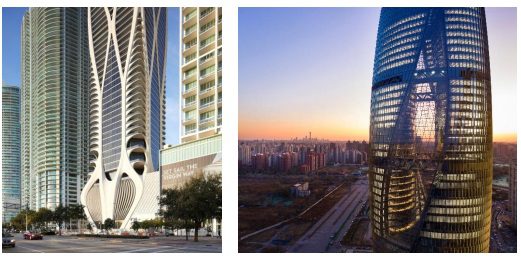
Highlighted projects include One Thousand Museum tower in Miami, and the Leeza SOHO tower in Beijing.
Regional Highlights The exhibition begins with a significant work of Zaha Hadid, on display near the entrance, The Peak project in Hong Kong. Though never built, the project was considered Hadid’s breakthrough project, metaphorically flipping Hong Kong’s iconic skyscrapers to generate a horizontal cluster of beams, with a large public void carved out between the geological intervention.
The Peak project won Hadid global attention and offered an early glimpse into the concepts and methodologies within ZHA’s work, as showcased in the exhibition – from the experimentation on structures that push the traditional boundaries, to floating fluid forms, as well as the integration of public spaces within dense urban environments.
The exhibition also presents two award-winning projects closer to home that encapsulate ZHA’s vision: the Morpheus Hotel at City of Dreams Macau, as well as the highly anticipated The Henderson tower to be completed in Central, Hong Kong.
The world’s first free-form high-rise exo-skeleton, the Morpheus Hotel at City of Dreams Macau opened in 2018 and was designed as a vertical extrusion of the site’s existing abandoned foundations. The 40-storey building of two internal vertical circulation cores connected at podium and roof levels to define its central atrium. The Henderson in Hong Kong creates an urban oasis. The 36-storey design reinterprets the One Thousand Museum © Hufton Crow Leeza SOHO © Hufton Crow Concept model of The Peak project in Hong Kong structural forms and layering of a Bauhinia bud about to blossom. Sheltering new civic plazas enveloped by nature, The Henderson connects with the adjacent public gardens and parks that flow into the generous communal spaces of the interior.
Other highlighted projects in the region includes Beijing Daxing International Airport and the Unicorn Island Masterplan project in Chengdu.
The online exhibition of “Zaha Hadid Architects: Vertical Urbanism” is available to view at: https://www.hkdi.edu.hk/en/hkdi_gallery/gallery.php?product_id=217.
As part of the comprehensive exhibition programme, a master lecture led by Patrik Schumacher and industry panel discussions will also be offered online in February and March respectively, in which architecture masters will dive deep into the theme of vertical urbanism, and examine the agenda of tower typology that will re-structure
urban societies in the 21st century.
“Zaha Hadid Architects: Vertical Urbanism” Online Exhibition