
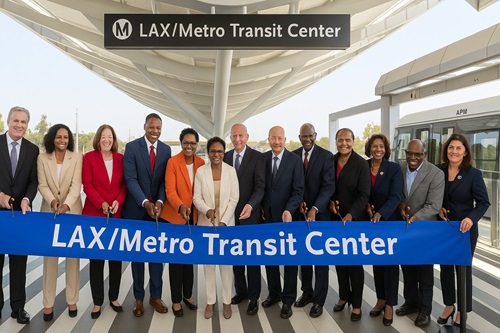
 After decades of dithering, detours and dreams, Los Angeles has done it — at long last, a proper train link to LAX. The ribbon has been cut, the tracks are live, and the future of travel in Tinseltown just found its tracks. Metro’s LAX/Metro Transit Center Station is officially open, connecting the airport to the region with the kind of flair usually reserved for red carpets.
Yes, dear reader — a real, functioning train station that connects weary travellers and wide-eyed tourists straight to LAX. It’s the transport revolution LA’s been promising since flares were fashionable and nobody knew what an Uber was. And now, as the city warms up for a triple bill of global spectacles — FIFA World Cup 2026, Super Bowl LXI, and the 2028 Olympic and Paralympic Games — Metro’s long game has finally paid off.
“The wait is over, Los Angeles,” declared Metro Board Chair and LA County Supervisor Janice Hahn with all the ceremonial pride of a monarch unveiling a new crown. “At long last, we are getting a train to LAX.”
It’s the eighth significant achievement in Metro’s ambitious “Twenty-Eight by ’28” initiative, designed to overhaul LA’s transport system ahead of the Olympic onslaught. The new station links Metro’s C and K lines with a sprawling hub of buses, shuttles, micro-transit, and — eventually — the long-anticipated Automated People Mover (APM), which will trundle travellers directly into the terminals by 2026.
And what a station it is. If architecture could strut, this one would be sashaying down the catwalk. With swooping canopies, 24/7 security monitoring, and enough space to land a zeppelin, the facility is the largest open-style Metro station in the system. It connects to six Metro bus lines and eight municipal ones — including Culver City Bus, Big Blue Bus and the LAWA shuttles — and services airport staff, travellers, and cost-conscious commuters alike.
LA Mayor and Metro Board Member Karen Bass put it best:
“This isn’t just a ride to the airport. This is about building a more connected, reliable and climate-conscious city for Angelenos and for the millions who will visit in the years ahead.”
Let’s be clear: this is more than just a convenient rail link. It’s a love letter to a future LA that finally acknowledges the old ways — gridlock, fumes, and forking out for a $60 cab to the terminal — are on their way out.
Supervisor Holly Mitchell called the station a “critical job connector,” particularly for airport-area workers who can now trade their bumper-to-bumper commute for a breezy train ride. And with LAX being not just one of the busiest airports on Earth but also a massive employment zone, this new station is a win for locals as much as visitors.
Metro’s CEO Stephanie Wiggins, who’s been leading the charge with the kind of tenacity that would make a triathlete blush, summed it up:
“This station not only enhances the travel experience for millions but also helps build a more sustainable and efficient transportation network for our city.”
And to add a little artistic sparkle, the station comes with its own piece of magic — The Distance of the Sun, a striking suspended sculpture by local artist Glenn Kaino, featuring vessels of imagined travel spiralling skywards. A visual metaphor, perhaps, for the journey LA has taken to get here: slow, ambitious, occasionally baffling — but finally airborne.
With its clean energy features, native landscaping, and seamless connections to what will soon be a fully integrated airport transport system, the LAX/Metro Transit Center is less about catching up and more about catching the future.
And while the APM won’t be online until 2026, shuttles will run every 10 minutes, syncing with light rail and bus arrivals. Once the People Mover finally rolls out, it’ll link six key stops: three in-terminal, one at the new station, another at economy parking, and the last at the sprawling Rent-A-Car mecca, ConRAC.
Inglewood Mayor and Metro Board Member James T. Butts hailed it as a game-changer for both visitors and locals:
“This state-of-the-art facility enhances connectivity, drives economic growth, and is a testament to our commitment to building a sustainable and inclusive future.”
From a public transport point of view, it’s a renaissance moment. Gone are the days of awkward rideshares, cross-terminal marathons, or praying for a rental car in peak hour. Now, whether you’re an Olympian or just late for a conference in Culver City, Metro’s got your back.
And perhaps most poignantly, as Metro Board Second Vice Chair Jacquelyn Dupont-Walker put it:
“This project redefines transit dependency to include those who choose to Go Metro.”
For Los Angeles, it’s not just about keeping up with the likes of London, Tokyo, or Sydney anymore — it’s about proving that a city once built for the car can reimagine itself on rails.
John Ackerman, CEO of Los Angeles World Airports, summed it up with grounded pride:
“This station connects LAX to the greater LA region — a monumental step that will transform how people travel.”
And with global eyes turning to Los Angeles in the coming years, the city’s transport infrastructure now has a fitting front door. One with a roofline that ripples like a Californian breeze and a promise — that LA is finally ready to meet the world, track by track.
For more details, visit: Metro LAX Transit Center Project; Metro Art.
By Jason Smith