
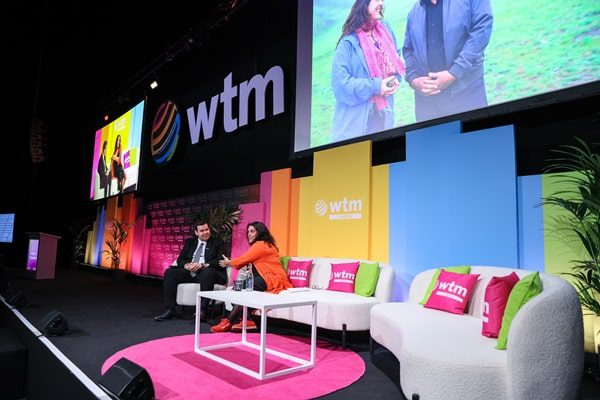
There’s never been a dull moment at World Travel Market London, but day two of the 2025 edition might just set a new benchmark for lively debate. Between arguments about artificial intelligence, musings on sustainability, and a surprisingly funny seminar on selling holidays through humour, the message was simple: the travel industry is getting serious and occasionally cheeky about its future.
The annual gathering at ExCeL London felt less like a trade show and more like a festival of competing philosophies. There were panels on inclusion and accessibility, earnest debates about technology, and just enough laughter to remind everyone that travel, at its best, is still about connection, not code.
Inclusion Takes the Spotlight – Again
The morning belonged to the DEAI Summit, where diversity, equity, accessibility and inclusion (increasingly lumped under one formidable acronym) were dissected with both passion and fatigue.
“There is definitely a rollback that is making it more challenging,” admitted Joanna Reeve from Intrepid Travel, acknowledging that inclusion efforts are facing pushback in some markets. “But travel connects us to other cultures — there’s less of ‘us and them’, and more just ‘us’.”
It was the kind of sentiment that earned nods across the room, though you could sense the weariness of professionals who’ve had to defend empathy as a business model.
Edgar Weggelaar from Queer Destinations put it bluntly. He said the anti-DEAI tone of recent U.S. politics had “an impact”, pointing to FBI data showing a rise in hate crimes. “We go where we feel comfortable and wanted,” he said. “That’s not politics — that’s human nature.”
Accessibility advocate Richard Thompson, of Inclu Group, took a sterner view. His research across 600 luxury hotels found more details online about pillow menus and pet policies than about accessibility. “We’re turning disabled travellers into gamblers,” he said, “staking thousands on a trip without knowing if the bathroom door’s wide enough.”
He called accessible travel “the last great untapped market,” and reminded the audience that only six per cent of disabled people use wheelchairs. The rest, he said, are waiting to be noticed.
Inclusion as a Business Strategy
If the morning began with frustration, it ended with pragmatism. Sadia Ramzan from The Muslim Women Travel Group showed how inclusion can be quietly profitable. “Something as small as welcoming Muslim guests with a mocktail instead of champagne,” she explained, “can turn them into lifelong advocates.”
She praised Japan’s halal certification system and modesty options in spas as proof that small gestures can open big markets.
Sita Sahu, of FUTURE&, took the long view. “At the moment, DEAI lives within HR and marketing,” she said. “By 2030, it’ll live within governance.” Translation: inclusion isn’t an optional extra, it’ll soon be written into the rulebook.
There were nods, applause, and no shortage of quiet note-taking from destination marketers. Thailand, fresh from passing its marriage equality law, and Malta, the seasoned LGBTQ+ leader, both held up banners of progress. Iceland’s tourism minister, Hanna Katrín Friðriksson, drew a line from the country’s 1975 Women’s Strike to its modern inclusivity drive. “Sometimes you have to stop the world for a day,” she said, “just to make it move again.”
AI Takes the Stand
After lunch, it was technology’s turn, and the mood shifted from idealism to curiosity (with a side of anxiety).
At the Media & Influencer Forum, content creators swapped notes on diversification. Having four or five income streams is the new normal. Colin Carter from Weather2Travel observed that AI-generated copy might flood the web, but it can’t replace the “boots-on-the-ground” insight of journalists. Still, he admitted the paradox: “We’re rewriting articles to make them more AI-friendly in search results.”
Frédéric Aouad of Stay22 got a laugh with: “Optimising affiliate links is a passion of nobody. AI can do that for you.”
Then came the Technology Summit, where the inevitable question “Is AI the enemy of travel?” became a mock courtroom drama. Stephen Joyce from Protect Group argued the case for humanity.
“AI itineraries remove the magical chaos of being somewhere new,”
he said, to murmurs of agreement.
But when the votes were counted, AI won by a landslide. “A tough day for the humans,” joked Christian Watts of Magpie, “but probably an accurate preview of the future.”
Shifting Markets, Shifting Mindsets
Meanwhile, in the Geo-Economics stream, yes, it’s as serious as it sounds; speakers discussed the art of redrawing source markets.
Shabib Al Maamari from Visit Oman explained how the sultanate partnered with Civitatis to attract Spanish and Portuguese travellers. “We found the market we wanted, and the partner who knew how to reach them,” he said.
The subtext? Everyone’s chasing the same travellers, and the competition is fierce. “There’s an aggressive race to acquire new source markets,” Al Maamari admitted, “and some destinations are supercharging their inbound flow by buying into their target markets.”
Sustainability: From Talk to Tactics
At the Sustainability Summit, things cooled down literally and philosophically. A panel titled Cool Tripping, Slow Tourism and the Sophisticated Traveller argued that sustainability has moved from buzzword to buying power.
Iain Powell from Hurtigruten presented the line’s new “open village” concept, in which cruisers mingle with locals and dine on hyperlocal produce sourced from 70 suppliers. The hybrid-powered ships are impressive, but the community connection is what sells it.
Tricia Schers from Planeterra shared success stories from India’s Women with Wheels taxi network and Peru’s Parwa Restaurant, both community-run ventures now supported by big players like Iberostar and easyJet Holidays.
Jane McFadzean of Trip.com Group exposed the “say-do gap”, the gap between travellers’ noble intentions and their actual bookings. “People talk about sustainability,” she said, “but still pick the cheapest flight.”
Her solution? Honest labelling. “Clear, credible, consistent. That’s what travellers need to make real choices.”
Trip.com is already testing its Country Retreats program in the Asia-Pacific, sustainable lodgings run by locals, for travellers who prefer authenticity to extravagance.
Comedy, Culture and the Marketing of Joy
In the marketing halls, the laughter was back quite literally. British comedian Maisie Adam led a session titled Comedy Sells, arguing that humour is travel’s secret handshake.
“You don’t have to show off Machu Picchu,” she grinned.
“You can film yourself stuck in an airport queue people relate to that.”
Her point was simple: connection sells better than perfection.
Later, historian and broadcaster Bettany Hughes reminded audiences that storytelling never goes out of fashion. In a conversation with Wanderlust’s George Kipouros, she revealed her history documentaries drew 450 million viewers last year. Clips of ancient artefacts from a 2,000-year-old Bulgarian perfume bottle to Pompeii paint pots went viral. Proof that even in a distracted digital age, curiosity still travels.
And in a charming twist, the West Midlands Growth Company shared its campaign featuring Black Sabbath’s Tony Iommi, a Shakespearean tour guide, and a taxi driver named William. The mix of grit and grace worked: the region’s international visitor numbers rose two per cent year-on-year.
The Verdict: A Travel Industry Growing Up
As the second day drew to a close, one takeaway emerged: travel is about learning to look inward before looking outward. Inclusion, AI, and sustainability are no longer novelties. They’re now the very infrastructure of modern tourism.
The tone at WTM London 2025 was hopeful, if a little self-aware. The industry knows it must do better, but it’s still capable of laughing at itself. And that, perhaps, is the healthiest sign of all.
By Bridget Gomez – (c) 2025
Read Time: 9 minutes.
About the Writer
 Bridget has never been one to sit still. Of Portuguese heritage, she first trained as a nurse. She threw herself into work at the Commonwealth Veteran Affairs Repatriation Hospital, tending to old soldiers with stories almost as colourful as her own would become. It was rewarding, steady work — but wanderlust has a louder voice than routine.
So, she swapped starched uniforms for a backpack and set off on a twelve-month gallop around the globe. Along the way, she scribbled in journals, capturing the dust, the laughter, the odd missed train, and the occasional glass of wine too many. Those notebooks soon became a travel blog, her way of reliving and sharing the journeys with anyone willing to read.
Eventually, Bridget stumbled across Global Travel Media and, in her words, “the rest is history.” Now she writes with the same mix of heart and mischief that fuelled her travels.
===============================