When the front of the plane starts filling up, you know business is looking healthy.
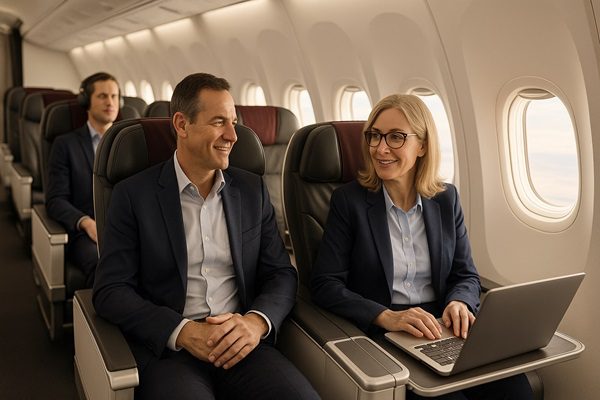
That was the unmistakable signal that Flight Centre Travel Group’s (FCTG) corporate arm delivered this week. Between FCM Travel and Corporate Traveller, the group’s FY25 results showed another record year of transaction growth and profits, much of it fuelled by the unashamed march of Australia’s executives into premium economy and business class cabins.
While the rest of us still squeeze into economy with knees wedged against the tray table, the nation’s corporate flyers are spreading out in reclined comfort, convinced that good business decisions require good legroom.
Premium economy: the new battleground
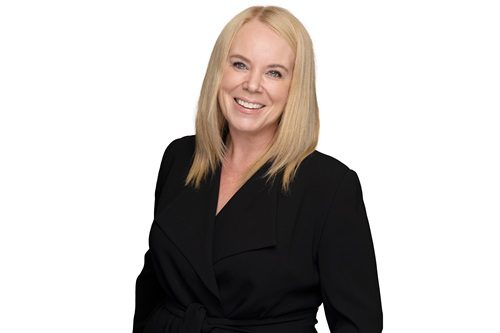
Melissa Elf, Global COO for FCM Travel and Corporate Traveller.
“We’re seeing an uptick in the premium economy and business class cabins in particular, both domestically and internationally,” said Melissa Elf, Global COO for FCM Travel and Corporate Traveller.
Premium economy is the star performer. Bookings surged nine per cent year-on-year (Sept 2024–Aug 2025), making it the fastest-growing cabin. Business class, that old warhorse of corporate travel, still managed a robust five per cent lift.
“Rising popularity at the front end of the plane reflects growth and stability across Australian businesses,” Elf explained. “It echoes our recent findings that FCM and Corporate Traveller customers are looking to spend more on travel in the year ahead.”
Corporate wallets open wide.
Globally, 45% of FCTG’s corporate customers plan to increase travel spending this financial year. In Australia, that figure climbs to 47%. Only a miserly 7% intend to spend less, while the majority 37%, are holding steady.
Elf sees it as a matter of necessity rather than extravagance:
“Companies are aware that the cost of doing business is getting more expensive. Those focused on growth are committing budget to activities that deliver returns, and travel is one of those non-discretionary spends that drives revenue.”
And in a delicious irony for those stuck in cattle class, productivity now comes with a wine list and noise-cancelling headphones. “There’s a real flock to the front of the plane,” Elf said. “Businesses are willing to pay for the more expensive cabins to get the greatest level of productivity and loyalty out of their travelling staff.”
First class fading, but not forgotten.
If the premium economy and business are booming, first class is looking slightly shopworn. Outside of Australia, the economy remains flat, but first class has declined.
“I think we’re seeing a slowdown in first class bookings due to the vast improvements on offer in the business cabin,” Elf observed. “Airlines are providing an incredible experience in business class that rivals first class.”
Ever competitive, airlines are reshaping their aircraft to cater to the new premium hierarchy. Business and premium economy sections are expanding. First class remains a ‘club within a club’, designed for ultra-high-net-worth travellers, VIP executives, and those who’d never dream of queueing at a boarding gate.
“First class will always have a certain appeal,” Elf conceded, “but it’s not seeing bookings growth by any means.”
Airlines sharpen their pencils.
With premium cabins generating the fattest margins, airlines are falling over themselves to upgrade the experience. Some are stripping out first class altogether, using the space to create larger and more luxurious business cabins. Others are experimenting with hybrid concepts, such as “business-plus” seats that edge closer to first without the eye-watering fares.
The result is that the competitive battleground of international aviation has shifted. It’s no longer just about getting from Sydney to Singapore on time; it’s about whether you get there with a bed that rivals your own at home.
Travel as a survival strategy.
What makes this trend remarkable is the timing. Australia, like much of the world, is navigating economic uncertainty. Inflation bites, energy costs rise, and yet corporate travel remains untouchable.
“This growth in business and premium economy cabins comes in a period of economic uncertainty,” Elf said. “Despite many businesses feeling the pinch, travel continues to be a necessity for corporate success and survival.”
In other words, you can trim the Christmas party budget and turn off the office lights at lunchtime, but not the travel account.
A national bellwether
The shift tells us more than where people sit on planes. It’s a bellwether for corporate confidence. When companies are willing to fund upgrades, they’re signalling optimism, growth ambitions, and the importance of keeping staff productive even at 38,000 feet.
For Flight Centre’s corporate division, it’s a validation of strategy. By focusing on premium and tailoring solutions for mid-to-large businesses, they’re riding the wave of a trend that looks set to endure.
For the rest of us, it’s confirmation that the curtain at row 12 isn’t coming down soon. In fact, it’s being pushed further back.
Conclusion: comfort equals commerce
Corporate Australia has spoken. Productivity is best achieved with champagne in hand, a fully flat bed, and working Wi-Fi. Economy class may still carry the bulk of travellers, but the business end of the plane is where the deals are signed, the mergers plotted, and the future of commerce quietly secured.
So next time you shuffle past those lie-flat thrones, remember: you’re not just looking at luxury. You’re looking at the machinery of business, humming along at 900 km/h.
By Michelle Warner