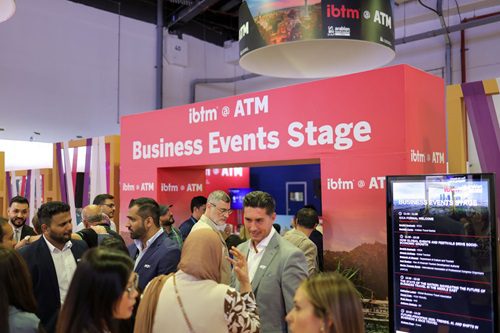
 Middle East business travel is barrelling into 2025 with a confidence that’s impossible to ignore in a region that doesn’t just bounce back but bounces higher. Forecasts unveiled at the freshly minted IBTM@ATM Business Events Stage during Arabian Travel Market (ATM) 2025 reveal that regional corporate travel spending will climb 6.1% this year, defying global caution and shrugging off post-pandemic jitters.
It seems the region, always one for grand gestures, has managed to outpace the rest of the world again, with business travel spend now sitting a hefty 19.4% above pre-COVID levels. That’s not recovery. That’s a renaissance.
According to the 2024 GBTA Business Travel Index Outlook Report, the Middle East accounted for a modest 1.2% of global business travel spending last year – $18.1 billion, to be precise. But it’s the trajectory that’s catching everyone’s attention. And make no mistake: this is not just momentum – it’s a mission.
From Tarmac to Boardroom: The Flight Path of Progress
Speaking at the event, Catherine Logan, Regional Senior Vice President for EMEA and APAC at the Global Business Travel Association (GBTA), didn’t mince words.
“The case for business travel in 2025 is strong,” Logan said firmly. “But it’s no longer just about booking flights and shaking hands. We’re seeing seismic shifts in the how, why and where of work travel. Economic conditions, tech evolution, tighter budgets, sustainable thinking – it’s all shaping a leaner, smarter, more intentional travel culture.”

Global deals, sharp suits and louder chatter—business travel’s back, baby.
And the Middle East? According to Logan, it’s leading the pack in showing how travel, when done right, drives progress—not just for businesses but also for governments, economies, and, most importantly, people.
The Numbers That Speak Louder Than Buzzwords
While the world wavers, the Middle East is striding ahead, fuelled by an ambitious slate of mega-projects, bilateral business plays, and a can-do attitude that borders on contagious. And nowhere is this more evident than in the surging demand along the Dubai-Riyadh corporate corridor.
“Try booking a midweek seat from Dubai to Riyadh,” quips Ciaran Kelly, Managing Director for Middle East & Africa at FCM Travel. “Good luck. And if you do land a seat, don’t expect an easy hotel check-in. Occupancy rates are brushing 80% across the region – the highest globally. We’re seeing unprecedented demand driven by everything from Expo legacies to Vision 2030 optimism.”
Kelly’s observations are backed not just by gut, but by data. FCM’s regional forecasts echo the broader IBTM@ATM sentiment: this isn’t just growth – it’s a full-throttle revival.
IBTM@ATM: Where Ideas, Insights and Itineraries Collide
The IBTM@ATM Zone, launched this year within the Arabian Travel Market, has become a beacon for business travel and MICE professionals across 166 countries. Its Business Events Stage is more than just a platform; it’s a proving ground for the conversations shaping tomorrow’s corporate journeys.
The sessions have tackled everything from AI integration and future-proofing strategies to the age-old tug-of-war between digital convenience and human connection. And if one thread runs through the entire tapestry, it’s this: adaptability is currency.
Danielle Curtis, Exhibition Director ME for Arabian Travel Market, summed it up pragmatically.
“Understanding the shifting dynamics of business travel isn’t just a nice-to-have. It’s a necessity. Companies that want to stay relevant need to stay informed, and events like IBTM@ATM equip them with the tools to do exactly that,” Curtis said.
She’s right. You can’t future-proof a business with last year’s travel policy.
The Green Elephant in the Room: Sustainability
No serious conversation about business travel in 2025 can skip the sustainability imperative. Logan made sure of that.
“We can no longer afford to look at travel purely through the lens of ROI,” she asserted. “We must consider its impact. And the good news? Sustainably managed business travel is not a compromise. It’s a force for good.”
From hybrid events to more thoughtful scheduling and carbon-conscious supplier choices, the sector is recalibrating—slowly, perhaps, but sincerely.
Looking Beyond the Horizon: Why It All Matters
The Middle East is writing its rulebook. While the rest of the world second-guesses, the region is investing. While others scale back, it scales up.
And it’s working.
The 32nd edition of Arabian Travel Market, themed ‘Global Travel: Developing Tomorrow’s Tourism Through Enhanced Connectivity,’ has attracted more than 55,000 travel professionals to Dubai’s World Trade Centre this week alone. It’s not just about optics – it’s about outcomes.
In a world bracing for volatility, the Middle East’s bullish approach to business travel offers something rare: assurance. And perhaps a blueprint.
As Logan eloquently said, “Business travel isn’t going away. It’s going forward.”
And if Dubai is anything to go by, it’s going first class.
By Jason Smith, Reporting from Arabian Travel Market, Dubai